
About
Technical
- DIMENSIONS,WEIGHTS, CAPACITIESOverall width (mm) 4615Overall height (mm) 1785Wheelbase (mm) 1710Front track (mm) 2630Rear track (mm) 1540Ground clearance (mm) 1560Luggage space VDA (ltr) 200Kerb weight (kg) MT / AT 527 - 952
SUSPENSION
Front
Toe control link MacPherson strut, coil spring, gas pressurised shock absorber, anti-roll bar
Rear
Reactive link double wishbone, coil spring, gas pressurised shock absorber, anti-roll barENGINE 2.0 DOHC i-VTEC
Bore x stroke (mm) 86 x 86
Capacity (cc) 1998
Compression ratio 9.8:1
Max. power kW/PS 110/150@ rpm 6,500
Max. torque Nm 192 @ rpm 4,000
Fuel system Honda PGM-F1
Fuel rating Unleaded 95 RonENGINE 2.2 i-CTDi
Bore x stroke (mm) 85 x 97.1
Capacity (cc) 2204
Compression ratio 16.7:1
Max. power kW/PS 103/140 @ rpm 4,000
Max. torque Nm 340@ rpm 2,000
Fuel system Common rail
Fuel rating Dieselmodel
cylinder
capacity
Maximum power
Max. Torque
Vmax
Acceleration,
0-100 km / hdrive
construction time
gasoline engine
2.0i
4
1998 cm³
110 kW (150 hp) at 6500 rpm
196 Nm at 4200 / min
190 km / h
10.2 s
4WD
09 / 2001-12 / 2006
diesel engine
2.2 i-CTDi
4
2204 cc
103 kW (140 hp) at 4000 rpm
340 Nm at 2000 rpm
187 km / h
10.6 s
4WD
10 / 2004-12 / 2006
Note: Full Specifications and Service Repair Manuals available for registered users
© Motor-car.net
Manuals
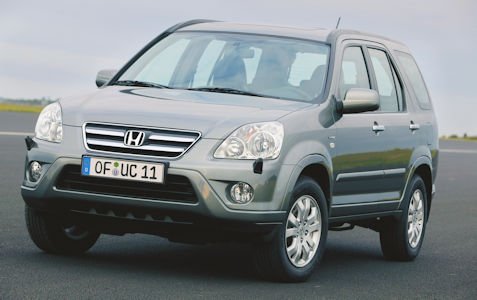
Honda CR-V 2nd generation
 |
|
|
Production period: |
2001 to 2006 |
|
Body versions : |
station wagon |
|
Engines: |
Gasoline : 2.0 litres (110 kW) |
|
Length: |
4635 mm |
|
Width: |
1785 mm |
|
Height: |
1710 mm |
|
Wheelbase : |
2630 mm |
|
Curb weight : |
1529-1692 kg |
The second-generation CR-V (model code RD), which was launched in autumn 2001, is available as a petrol engine (2.0 l VTEC ) or as a diesel variant (2.2 lU CTDi ). With folded rear bench, it offers a capacity of up to 952 litres Brakes are now uprated across the range, with 300 mm diameter ventilated discs at the front and 305 mm solid discs at the rear.
Honda offers three different trim levels: from the LS version with steel wheels and fabric interior, through the ES version with aluminium rims and ESP , to the executive version with leather trim. Fresh new styling both front and rear introduces a more distinctive, ‘refined toughness’, improvements to the interior include new backlit instrumentation, and Honda’s intelligent, on-demand 4WD system has been enhanced to make it even more responsive. Safety gets a further boost with the introduction of side curtain airbags and Vehicle Stabilty Assist (VSA), while larger, 16 inch wheels fitted as standard are matched to larger disc brakes all round. standard front and side airbags, double pre-tensioners on front seatbelts, three rear 3-point seatbelts, Isofix child seat mountings (on outer rear seats) and whiplash-reducing front seats.
The CR-V features Real Time 4WD , a four- wheel drive that automatically engages at low traction . To ensure safety in the CR-V, up to six airbags and the active driving safety electronic systems ( ABS , electronic brake force distribution and the Honda VSA (Vehicle Stability Assist) called ESP) contribute. In the fall of 2004, a slight facelift. Engine side came a 2.2 Liter diesel with 103 kW (140 hp) in the program. The CR-V’s familiar 110kW/ 150 PS 2.0 litre DOHC i-VTEC petrol engine mated to either a 5-speed manual or 4-speed automatic transmissions .The engine is now Euro IV compliant.
The CR-V boasts one of the most spacious cabins in its class. The distance between the hip points of front and rear passengers is 1007 mm (maximum value), and load volume ranges from 527 to 628 litres (VDA) (to the windowline) depending on the position of the sliding rear seats (they have 170 mm of movement in five steps). When the 60:40 split rear seats are tumbled forwards into their almost vertical storage position – there is no need to remove headrests first – that figure rises to 952 litres (up to the windowline). It means that two 26 inch mountain bikes can be carried upright without the need to remove their front wheels.Convenience features abound, including the innovative waterproof storage container positioned beneath the load floor, with a lid that doubles as a picnic table.
The lack of gear reduction, the off-road engine and transmission concept, and the self-supporting body with independent suspension do not make the CR-V a commonly used off-road vehicle designed for off-road use. The built-in four-wheel drive system is more of driving safety in certain traffic situations than the easier way forward in rough terrain. The direct competitors of the CR-V are the Kia Sportage , Hyundai Tucson or the Toyota RAV4 .
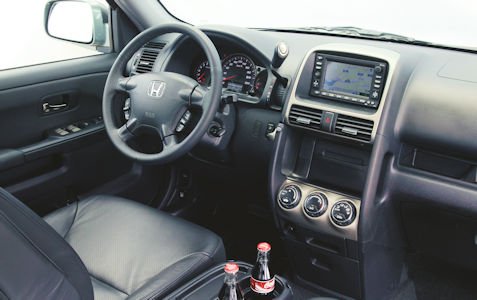
Among the later revisions are a new steering wheel with cruise control switches located on the right hand side (where fitted) and audio on the left hand side a channel switch at the top, a mode switch at the bottom and a central rocker switch for volume; revised door armrests; new damped storage type grab handles, chrome trimmed inner door handles, vent controls and heater control surrounds; and standard on the Executive grade, and optional on Sport, leather trimmed steering wheel, gear shift knob, and door lining, together with heated front seats. The main instrumentation now appears as a darkened panel with the ignition off, transforming to a bright display when the door lock is released and an even higher contrast one when the ignition is switched on, thanks to the use of backlighting. The instruments feature white numerals and red-illuminated needles and surround. A digital information display positioned within the speedometer shows real time fuel consumption, odometer and trip; it will also display ambient temperature or average fuel consumption in place of the odometer, as well as a second trip reading. 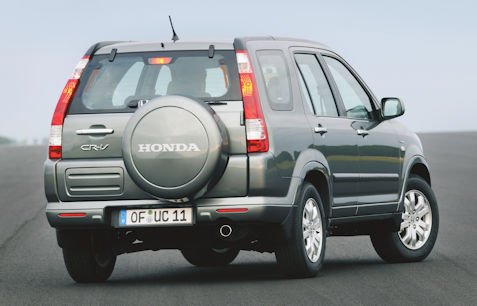
|
Featured
|
|

