
About
Technical
-
Maserati Biturbo Technical details and specifications (1981-1994)
ENGINE: 2.0L
location front
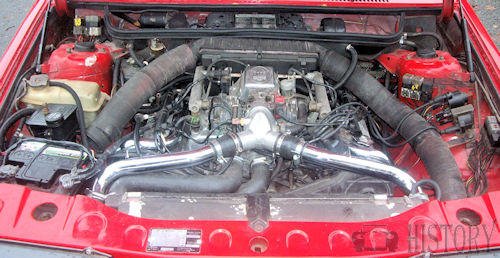
4 stroke,6 cylinders, Vee-slanted at 90°
Engine capacity: 121.8 cu in, 1,996 cc (3.23 x 3.50 in, 82 x 63.5 mm)
compression ratio: 7.8:1
light alloy block and head, wet liners, hemispherical combustion chambers
4 crankshaft bearings
valves: 3 per cylinder (two intake and one exhaust in main combustion chamber), overhead, thimble tappets
camshafts: 2, 1 per bank, overhead, cogged belt
lubrication: gear pump, full flow filter
1 Weber downdraught twin barrel carburettor, with 2 IHI exhaust turbochargers, 1 per bank
fuel feed: electric pump
water-cooled, electric thermostatic fan.TRANSMISSION
driving wheels: rear
clutch: single dry plate (diaphragm), hydraulically controlled
gearbox: ZF mechanical; gears: 5, fully synchronized
gearbox ratios: 1st 3.420, 2nd 2.080, 3rd 1.390, 4th 1, 5th 0.870, rev 3.660
gear lever location: central
final drive: hypoid bevel
axle ratio: 3.730
(Optional) ZF SHP 22 automatic transmissionCHASSIS
type integral
front and rear suspension: independent, by McPherson, coil springs/telescopic damper struts, wishbones, anti-roll bar.STEERING
rack-and-pinion, adjustable tilt and height of steering wheel, servo.
turning circle: 55.4 ft, 11.7 m.
(Optional) power steeringBRAKES
disc, dual circuit, servo.ELECTRICAL EQUIPMENT
12 V
50 Ah battery
65 A alternator
electronic ignition
4 iodine headlamps.DIMENSIONS AND WEIGHT
wheel base: 98.98 in, 251 cm
tracks: 55.91 in, 142 cm front, 56.34 in, 143 cm rear
length: 165.5O in, 415 cm
width: 67.48 in, 171 cm
height: 51.38 in, 130 cm
ground clearance: 4.92 in, 12.5 cm
weight: 2,395 1b, 1,086 kg© Motor car History
Service
-
Maserati Biturbo Maintenance and Service Guide (1981-1994)
fuel:97 oct petrol
oil: engine 10.6 pt, 12.7 US pt. 6 1, SAE 10W-50, change every 3,100 miles, 5,000 km
gearbox 2.6 imp pt, 8.2 US pt, 1.5 1, SAE 90, chance every 12.400 miles, 20,000 km
final drive 2.5 imp pt, 3 US pl. 1.4 1, SAE 90, change every 12,400 miles, 20,000 km
tyre pressure: front 2.3 atm, rear 2.3 atm.
width of rims: 5.5"
tyres: 195/60 HR x 14
carrying capacity: 882 1b, 400 kg© Motor car History
Manuals
Maserati Biturbo
| 1981 to 1994 | |
|---|---|
 |
|
| Overview | |
| Manufacturer | Maserati |
| Production | 1981–1994 |
| Assembly | Modena, Italy |
| Designer | Pierangelo Andreani Zagato (Spyder) |
| Body and chassis | |
| Class | Sports / Luxury |
| Body style | 2-door coupé 4-door sedan 2-door cabriolet |
| Layout | FR layout |
| Powertrain | |
| Engine | 2.0 L twin-turbo V6 2.5 L twin-turbo V6 2.8 L twin-turbo V6 |
| Transmission | 5-speed manual 3-speed automatic |
| Dimensions | |
| Wheelbase | 251 cm (98.8 in) (Coupé) 260 cm (102.4 in) (Sedan, 228) 240 cm (94.5 in) (Spyder) |
| Length | 415 cm (163.4 in) (Coupé) 440 cm (173.2 in) (Sedan) 404 cm (159.1 in) (Spyder) 445 cm (175.2 in) (228) |
| Width | 171 cm (67.3 in) (Coupé, Spyder) 173 cm (68.1 in) (Sedan) 186 cm (73.2 in) (228) |
| Height | 131 cm (51.6 in) (Coupé, Spyder, 228) 136 cm (53.5 in) (Sedan) |
| Chronology | |
| Predecessor | Maserati Merak |
| Successor | Maserati Shamal and Ghibli II |
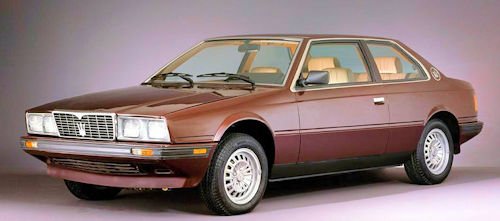
The Maserati Biturbo (Tipo 116) is a sports car introduced by Maserati in 1981. The Biturbo is a two-door, four-seater notchback coupé (of somewhat smaller dimensions than the BMW 3 Series of the time) featuring, as the name implies, a two-litre V6 engine with two turbochargers and a luxurious interior. The car was designed by Pierangelo Andreani, an engineer from the De Tomaso team, somewhat influenced by the design of the newer Quattroporte III (Italdesign Giugiaro), as can be observed on the front fascia.
All Maserati models from the Biturbo's introduction in 1981 until 1997 (except the Quattroporte III) were based on the original Biturbo architecture, among them the four-door 420/425 and 4.24v, the Spyder, the Karif, the 228 and 2.24v, the Maserati Racing and the later Shamal and Ghibli II, as well as Maserati Barchetta which used an ultimate version of the V6 engine.
History
When Alejandro de Tomaso acquired Maserati in 1976, he had ambitious plans for the marque. His plan was to combine the prestige of the Maserati brand with a sports car that would be more affordable than the earlier high-priced models that had traditionally made up the Maserati range. In fact, Maserati ceased making supercars like the ones developed under Citroën ownership altogether, like the Bora and Khamsin.
The Biturbo was initially a strong seller and brought Italian prestige to a wide audience, with sales of about 40,000 units. Sales figures fell in subsequent years. De Tomaso also used another of his companies, Innocenti, to produce Biturbo body panels and also to provide final assembly of Biturbos. De Tomaso later sold Maserati to Fiat, who grouped the company with their erstwhile rival Ferrari.
Export versions came initially with a 2.5L V6, after 1989 it was enlarged to 2.8 litres, while for Italy a two-litre high-performance version was originally produced (to avoid the 38% sales tax imposed at the time on cars displacing more than 2000 cc). The aluminum 90-degree SOHC V6 engine was roughly based on the 2.0 L Merak engine, itself based on earlier V8 Formula One Maserati engines, designed by Giulio Alfieri (1924–2002). The carbureted 2.5L engine produced 185 hp (138 kW) and 208 lb·ft (282 N·m) of torque in North American spec and slightly more elsewhere. Fuel injection was fitted in 1987 raising power to 187 hp (139 kW). In 1989 the 2.8L engine bumped power to 225 hp (168 kW) and 246 lb·ft (334 N·m) of torque for North America and 250 hp (186 kW) for Europe.
The Biturbo competed unsuccessfully in the British Touring Car Championship in the late 1980s, the European Touring Car Championship and the World Touring Car Championship (1987).
Biturbo engines
The Maserati Biturbo was the first ever production twin-turbocharged engine. The 2-litre version featured wet aluminium sleeves coated with Nikasil. The last street version featured over 150 hp/litre and 140 ft·lbf (190 N·m)/litre torque.
PERFORMANCE: 2.0L
- max power (DIN): 180 hp (132 kW) at 6,000 rpm
- max torque (DIN): 188 1b ft, 26 kg m (255 Nm) at 3,500 rpm
- max engine rpm: 6,400; 90.2 hp/l (66.1 kW/l)
- power-weight ratio: 13.3 lb/hp (18.1 lb/kW), 6 kg/hp (8.2 kg/kW)
- fuel consumption: 24.1 m/imp gal, 20.1 m/US gal, 11.7 1 x 100 km at 75 mph, 120 km/h.
- max speeds: (l) 34 mph, 55 km/h; (Il) 56 mph, 90 km/h; (Ill) 84 mph, 135 km/h; (IV) 116 mph, 187 km/h; (V) 134 mph, 215 km/h
A V6 1996 cc DOHC 36-valve (6 valves per cylinder) engine was developed but never manufactured.
| Series | Displacement | Head | Fuel system | Model |
|---|---|---|---|---|
| AM 452 | 2000 cc | 18 valves | carburetor | Biturbo, Biturbo S |
| AM 453 | 2500 cc | 18 valves | carburetor | Biturbo 2500 |
| AM 470 | 2000 cc | 18 valves | injection | Biturbo i |
| AM 471 | 2000 cc | 18 valves | injection | Si, 2.22S, 2.22SR, 4.18, 4.30, Spyder |
| AM 472 | 2500 cc | 18 valves | injection | Biturbo 2500i |
| AM 473 | 2800 cc | 18 valves | injection | 4.30, 222SR, Spyder, Karif |
| AM 475 | 2000 cc | 24 valves | injection | 2.24, 4.24, Spyder |
| AM 490 | 2000 cc | 24 valves | injection | Racing, Barchetta Stradale |
| AM 495 | 2000 cc | 24 valves | injection | Ghibli II |
| AM 496 | 2000 cc | 24 valves | injection | Ghibli Cup |
| AM 477 | 2800 cc | 24 valves | injection | 2.22 4V, 430 4V, Ghibli II |
| AM 501 | 2000 cc | 24 valves | injection | Barchetta Corsa |
Biturbo
The first Biturbo version was introduced in December 1981 as a two-door coupe. The Biturbo name disappeared when the car was significantly redesigned in 1988 and after 1994 became the Ghibli II.
Versions:
| Model | Years | Engine | Displacement | Power | Fuel system | Units |
|---|---|---|---|---|---|---|
| Biturbo | 1982–85 | V6 ohc | 1995 cc | 180 hp | carburetor, turbo | 9206 |
| Biturbo E | 1983–85 | V6 ohc | 2491 cc | 185 hp | carburetor, turbo | 4577 |
| Biturbo S | 1983–86 | V6 ohc | 1995 cc | 205 hp | carburetor, turbo | 1038 |
| Biturbo ES | 1984–85 | V6 ohc | 2491 cc | 205 hp | carburetor, turbo | 1480 |
| Biturbo II | 1985–87 | V6 ohc | 1995 cc | 180 hp | carburetor, turbo | (Biturbo) |
| Biturbo 2.5 S | 1984–87 | V6 ohc | 2491 cc | 196 hp | carburetor, turbo | (Biturbo ES) |
| Biturbo 2.5 E II | 1985–87 | V6 ohc | 2491 cc | 185 hp | carburetor, turbo | (Biturbo E) |
| Biturbo S II | 1985–86 | V6 ohc | 1995 cc | 210 hp | carburetor, turbo | (Biturbo S) |
| Biturbo i | 1986–90 | V6 ohc | 1995 cc | 188 hp | Fuel injection, turbo | 683 |
| Biturbo Si | 1986–88 | V6 ohc | 1995 cc | 220 hp | Fuel injection, turbo | 992 |
| Biturbo Si Black | 1986–88 | V6 ohc | 1995 cc | 220 hp | Fuel injection, turbo | 450 |
| Biturbo 2.5 Si | 1986–88 | V6 ohc | 2491 cc | 188 hp | Fuel injection, turbo | 430 |
| 2.24V | 1988–92 | V6 dohc | 1996 cc | 245 hp | Fuel injection, turbo | 1147 |
| 222 | 1988–90 | V6 dohc | 1996 cc | 220 hp | Fuel injection, turbo | 1156 |
| 222 4v | 1991–93 | V6 dohc | 2790 cc | 279 hp | Fuel injection, turbo | 130 |
| 222 E | 1988–90 | V6 ohc | 2790 cc | 250 hp | Fuel injection, turbo | 722 |
| 222 E | 1988–90 | V6 ohc | 2790 cc | 225 hp | Fuel injection, turbo | (222 E) |
| 222 SE | 1990–91 | V6 ohc | 2790 cc | 250 hp | Fuel injection, turbo | 210 |
| 222 SE | 1990–91 | V6 ohc | 2790 cc | 225 hp | Fuel injection, turbo | (222 SE) |
| 2.24V II | 1991–93 | V6 dohc | 1996 cc | 240 hp | Fuel injection, turbo | 254 |
| 222 SR | 1991–93 | V6 ohc | 2790 cc | 225 hp | Fuel injection, turbo | (222 SE) |
| Racing | 1990–92 | V6 dohc | 1996 cc | 285 hp | Fuel injection, turbo | 230 |
420/425/430
Two years after Biturbo introduction was unveiled a four-door family version. This version has a longer wheelbase, 2.6 metres (100 in). The four-door version was replaced in 1994 with the Maserati Quattroporte IV.
Versions:
| Model | Years | Engine | Displacement | Power | Fuel system | Units |
|---|---|---|---|---|---|---|
| 425 | 1983–89 | V6 ohc | 2491 cc | 200 hp | carburetor, turbo | 2372 |
| 420 | 1985–86 | V6 ohc | 1995 cc | 180 hp | carburetor, turbo | 1686 |
| 420i | 1986–88 | V6 ohc | 1995 cc | 190 hp | Fuel injection, turbo | 1124 |
| 420 S | 1985–87 | V6 ohc | 1995 cc | 210 hp | carburetor, turbo | 254 |
| 420 Si | 1986–88 | V6 ohc | 1995 cc | 220 hp | Fuel injection, turbo | 524 |
| 430 | 1987–94 | V6 ohc | 2790 cc | 225 hp | Fuel injection, turbo | 995 |
| 425i | 1987–89 | V6 ohc | 2491 cc | 188 hp | Fuel injection, turbo | 425 |
| 422 | 1988–92 | V6 dohc | 1996 cc | 220 hp | Fuel injection, turbo | 978 |
| 4.18v | 1990–92 | V6 ohc | 1995 cc | 220 hp | Fuel injection, turbo | 77 |
| 4.24v | 1990–92 | V6 dohc | 1996 cc | 245 hp | Fuel injection, turbo | 384 |
| 4.24v II | 1991–93 | V6 dohc | 1996 cc | 240 hp | Fuel injection, turbo | 490 |
| 430 4v | 1991–93 | V6 dohc | 2790 cc | 279 hp | Fuel injection, turbo | 291 |
Spyder
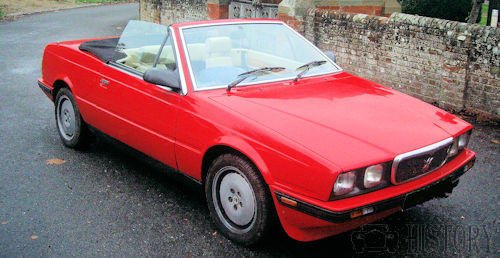
The Spyder (Tipo 333) version was introduced at the Turin Motor Show in 1984. The car was designed and built by Zagato, their first work for Maserati since the A6G/2000 of thirty years earlier. Also Carrozzeria Embo was commissioned to develop a four-seater cabriolet version of the Biturbo, but this never made it into production. The Spyder version has a shorter wheelbase, 2.4 metres (94 in). Still, since it is a strict two-seater with folding rear seats, the luggage space is larger than in the original Biturbo. On this shorter chassis the sporty hardtop Karif was later developed. Overall 3,076 were built over a ten-year period, setting a production record for Maserati Spyders.
Versions:
| Model | Years | Engine | Displacement | Power | Fuel system | Units |
|---|---|---|---|---|---|---|
| Spyder 2.0 | 1984–88 | V6 ohc | 1,996 cc | 180 hp | carburetor | 276 |
| Spyder 2.5 | 1984–88 | V6 ohc | 2,491 cc | 192 hp | carburetor, turbo | 1,049 |
| Spyder 2.0i | 1986–87 | V6 dohc | 1,996 cc | 185 hp | Fuel injection, turbo | 297 |
| Spyder 2.0i | 1987–88 | V6 dohc | 1,996 cc | 195 hp | Fuel injection, turbo | (Spyder 2.0) |
| Spyder 2.5i | 1988–89 | V6 ohc | 2,491 cc | 188 hp | Fuel injection, turbo | (Spyder 2.5) |
| Spyder 2.8i | 1989–91 | V6 ohc | 2,790 cc | 250 hp | Fuel injection, turbo | 603 |
| Spyder 2.8i | 1989–91 | V6 ohc | 2,790 cc | 225 hp | Fuel injection, turbo | (Spyder 2.8i) |
| Spyder 2.0iE | 1989–91 | V6 dohc | 1,996 cc | 220 hp | Fuel injection, turbo | 122 |
| Spyder III 2.0 | 1991–94 | V6 dohc | 1,996 cc | 245 hp | Fuel injection, turbo | 309 |
| Spyder III 2.8 | 1991–94 | V6 dohc | 2,790 cc | 225 hp | Fuel injection, turbo | 220 |
| Spyder III 2.0 | 1991–94 | V6 dohc | 1,996 cc | 240 hp | Fuel injection, turbo | 200 |
228
The Maserati 228 is a two-door Gran turismo model, targeting the same markets as had earlier bought 3500 GTs and Mexicos. The 228 was introduced at the 1986 Turin Motor Show, it uses the longer four-door chassis and the bigger 2.8-litre biturbo engine in a two-door coupe form with a more luxurious interior than the usual two-door cars. 469 examples of the 228 were built up until 1992.
Versions:
| Model | Years | Engine | Displacement | Power | Fuel system | Notes |
|---|---|---|---|---|---|---|
| 228 | 1986–92 | V6 ohc | 2790 cc | 250 hp | Fuel injection, turbo | |
| 228 | 1986–92 | V6 ohc | 2790 cc | 225 hp | Fuel injection, turbo | Catalysator |
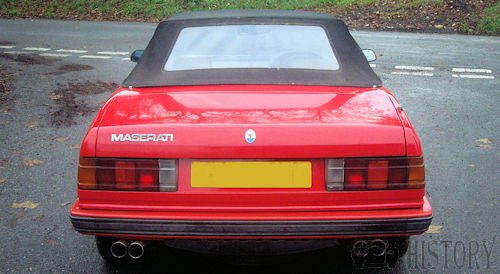
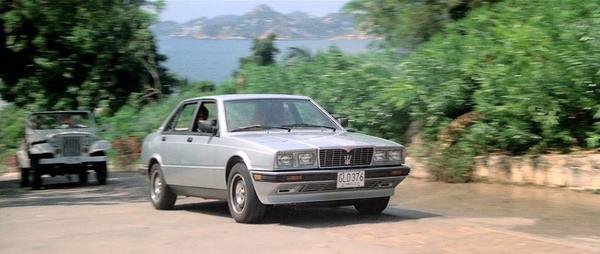
1987 Maserati Biturbo 425i in Licence to Kill. Driven by Franz Sanchez
|
Featured
|
|

