
About
Technical
-
Nissan Primera (1996-1997)
1.6
2.0
2.0 SRi / SE
2.0 GT
2.0 TD
Construction period
06 / 1996-08 / 1997
01 / 1997-08 / 1997
06 / 1996-08 / 1997
Karosserievariante
Notchback, hatchback
notchback
Notchback, hatchback
Motor characteristics
engine type
R4 petrol engine
R4 diesel engine
Number of valves per cylinder
4
2
valve control
DOHC , chain
OHC, timing belt
mixture preparation
manifold injection
Swirl chamber injection
engine charging
-
turbocharger
cooling
water cooling
motor identification
GA16DE
SR20De
SR20DE
CD20T
Bore × stroke
76.0 × 88.0 mm
86.0 × 86.0 mm
84.5 × 88.0 mm
capacity
1597 cm³
1998 cm³
1974 cm³
compression ratio
9.8: 1
10.0: 1
22.2: 1
Max. power
66 kW
(90 hp)
at 6000 rpm85 kW
(115 hp)
at 5600 rpm96 kW
(131 hp)
at 5600 rpm110 kW
(150 hp)
at 6100 rpm66 kW
(90 hp)
at 4400 rpmMax. torque
136 Nm
at 4000 rpm166 Nm
at 4800 rpm173 Nm
at 4800 rpm181 Nm
at 4800 rpm177 Nm
at 2400 rpmpower transmission
drive
front-wheel drive
transmission
5-speed manual transmission
readings
top speed
178 km / h
198 km / h
205 km / h
218 km / h
174 km / h
Acceleration, 0-100 km / h
11.7 s
9.8 s
9.6 s
8.6 s
13.9 s
Fuel consumption per 100 km (combined)
7.3 l s
7.9 l s
8.1 l s
6,7 l D
In the course of the model maintenance the engines were revised. The 1.6 now made 100 hp, and the 2.0 with 115 hp was taken out of the offer.
Datasheet Nissan Primera (1997-1999)
1.6
2.0
2.0 TopSport / STWline
2.0 TD
Construction period
09 / 1997-07 / 1999
Karosserievariante
Limousine, station wagon
limousine
Limousine, station wagon
Motor characteristics
engine type
R4 petrol engine
R4 diesel engine
Number of valves per cylinder
4
2
valve control
DOHC , chain
OHC, timing belt
mixture preparation
manifold injection
Swirl chamber injection
engine charging
-
turbocharger
cooling
water cooling
motor identification
GA16DE
SR20DE
CD20T
Bore × stroke
76.0 × 88.0 mm
86.0 × 86.0 mm
84.5 × 88.0 mm
capacity
1597 cm³
1998 cm³
1974 cm³
compression ratio
9.8: 1
9.5: 1
10.0: 1
22.2: 1
Max. power
73 kW
(99 hp)
at 6000 rpm96 kW
(131 hp)
at 5600 rpm110 kW
(150 hp)
at 6100 rpm66 kW
(90 hp)
at 4400 rpmMax. torque
136 Nm
at 4000 rpm170 Nm
at 4800 rpm181 Nm
at 4800 rpm177 Nm
at 2400 rpmpower transmission
drive
front-wheel drive
Gearbox, standard
5-speed manual transmission
Gear, optional
-
4- speed automatic transmission
-
Measurements (Limousine) [B 1]
top speed
180 km / h
205 km / h
(198 km / h)218 km / h
174 km / h
Acceleration, 0-100 km / h
12.0 s
9.6 s
(11.2 s)8.6 s
13.9 s
Measurements (combi) [B 1]
top speed
175 km / h
200 km / h
(190 km / h)-
170 km / h
Acceleration, 0-100 km / h
12.8 s
10.5 s
(11.7 s)-
14.6 s
↑ Jump up to:a b Values in () for automatic transmission.
With the introduction of the P11-144 the engine offer was revised again. For the launch of the Primera in Europe for the first time a 1.8l four-cylinder engine with 113 hp was available, the valve control is also done via two overhead camshafts and a timing chain. Furthermore, the 2.0l engine with 131 hp was removed from the program and throttled the 150 hp version to 140 hp. The 1.6 liter gasoline engine (until the beginning of 2001) and the diesel engine remained unchanged.
Nissan Primera (1999-2002)
1.6
1.8
2.0
2.0 TD
Construction period
08 / 1999-12 / 2000
12 / 2000-03 / 2002
08 / 1999-03 / 2002
Karosserievariante
Limousine, station wagon
limousine
Limousine, station wagon
Motor characteristics
engine type
R4 petrol engine
R4 diesel engine
Number of valves per cylinder
4
2
valve control
DOHC , chain
OHC, timing belt
mixture preparation
manifold injection
Swirl chamber injection
engine charging
-
turbocharger
cooling
water cooling
motor identification
GA16DE
QG16DE
QG18DE
SR20DE
CD20T
Bore × stroke
76.0 × 88.0 mm
80.0 × 88.0 mm
86.0 × 86.0 mm
84.5 × 88.0 mm
capacity
1597 cm³
1769 cc
1998 cm³
1974 cm³
compression ratio
9.8: 1
k. A.
9.5: 1
10.0: 1
22.2: 1
Max. power
73 kW
(99 hp)
at 6000 rpm78 kW
(106 hp)
at 6000 rpm83 kW
(113 hp)
at 5600 rpm103 kW
(140 hp)
at 5800 rpm66 kW
(90 hp)
at 4400 rpmMax. torque
136 Nm
at 4000 rpm140 Nm
at 4000 rpm158 Nm
at 2800 rpm181 Nm
at 4800 rpm177 Nm
at 2400 rpmpower transmission
drive
front-wheel drive
Gearbox, standard
5-speed manual transmission
Gear, optional
-
Stepless CVT transmission
-
Measurements (Limousine) [C 1]
top speed
180 km / h
186 km / h
196 km / h
210 km / h
(202 km / h)175 km / h
Acceleration, 0-100 km / h
12.0 s
11.0 s
9.6 s
(11.5 s)14.0 s
Fuel consumption per 100 km (combined)
7.2 l s
k. A.
7.3 l s
8.1 l S
(8.5 l S)6.5 l D
CO 2 emission (combined)
186 g / km
k. A.
180 g / km
195 g / km
(206 g / km)179 g / km
Measurements (combi) [C 1]
top speed
176 km / h
-
191 km / h
205 km / h
(195 km / h)170 km / h
Acceleration, 0-100 km / h
12.8 s
-
11.7 s
11.5 s
(12.0 s)14.6 s
Fuel consumption per 100 km (combined)
7.5 l s
-
7.4 l s
8.3 l S
(8.7 l S)6,7 l D
CO 2 emission (combined)
194 g / km
-
186 g / km
200 g / km
(211 g / km)186 g / km
↑ Jump to:a b Values in () for CVT transmission.
Note: Full Specifications and Service Repair Manuals available for registered users
© Motor-car.net
Manuals
Nissan Primera Second Generation (P11)
 |
|
|
Production period: |
1996 to 2002 |
|
Body versions : |
Sedan , station wagon |
|
Engines: |
Gasoline : 1.6-2.0 liters |
|
Length: |
4430 mm |
|
Width: |
1700 mm |
|
Height: |
1410 mm |
|
Wheelbase : |
2600 mm |
|
Curb weight : |
1240-1355 kg |
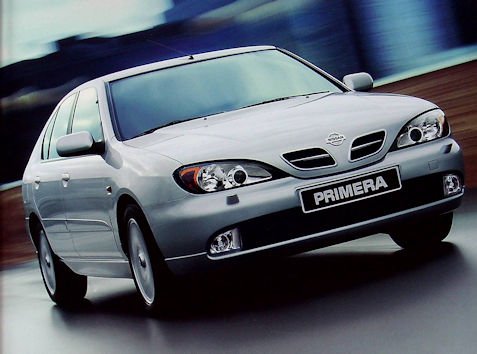
The P11 series of the car manufacturer Nissan was the second model of the Primera . Until the first facelift was not a Traveler ( station wagon ) available in addition to the sedan with stepped or hatchback . To close this gap, the previous generation station wagon continued to be sold. The Primera P11 was sold in the US as the Infiniti G20 .
The official introduction of the Primera P11 was in September 1996 as notchback and hatchback. A wagon version of this model was not built until the first facelift, instead was still the W10 Traveler of the previous model available. The new edition of the Primera had grown in all dimensions and offered more space in the interior. Also, the P11 came up with greatly improved safety features. Thus, double airbags front, belt tensioner and ABS were standard in every version on board.
The chassis has also been greatly improved. Although the double wishbone front axle still came from the predecessor model Primera P10 , but the rear suspension was completely changed. The so-called compact-link rear suspension was used, in which a Scott Russell linkage is installed. This was already used in the Almera N15 and Maxima A32 , but the compact handlebar rear axle in the Primera P11 was for the first time combined with the double wishbone front axle. The on the Nürburgring Nordschleife tuned suspension earned good reviews for his handling.
For the launch of the Primera P11 three gasoline engine with intake manifold injection and a diesel engine were available. The petrol engines came with slight modifications from the previous model P10, only a 2.0l engine with 131 hp was added to the program. Among the petrol engines, a new 2,0l- came turbodiesel with swirl chamber injection and 90 hp added. The turbo diesel was not newly developed, but it was the well-known CD20 diesel from the P10 and Sunny, it was only a permanent working turbocharger used and the engine was called CD20T. In April 1997, the engine range was expanded by a sports model, the GT, with 150 hp from a 2.0-liter engine.
As an engine only Nissan engines were offered, which were designed as a four-cylinder . The gasoline engines have 16 valves , which are driven by a timing chain via two overhead camshafts ( DOHC ). The diesel engine, however, has only 8 valves, which are operated via an overhead camshaft ( OHC ). Here the valve is controlled by a toothed belt .
Equipment variants
GX: presented the basic version, equipped with power steering, central locking, exclusively with 1.6l engine
Si: this equipment was the sportier basic variant, equipped with leather steering wheel, sport seats, rear spoilers and fog lights , only with 1.6l engine
SLX: this equipment was the standard equipment with velor seats, electric. Window regulators and mirror adjustment, but without air conditioning as standard
SRi: the standard sports equipment with leather steering wheel, sports seats, ZV, sports suspension, strut bars, rear spoiler
SE: luxury equipment with air conditioning, velor , leather steering wheel, BC , ZV with remote control , LM rims , wood decor, electr. Window regulators, chrome handles, with leather upholstery for an extra charge. Only with 2.0 l engine
GT: the Primera GT was the top model of the P11, equipped with partial leather sports seats, leather steering wheel, power windows, air conditioning, strut bars , sports suspension, side skirts, extended front and rear aprons, rear spoiler, BC, ZV with remote control. This model was available from April 1997 only with 2.0l engine (SR20DE) (150 hp) and as a saloon. It served as Homologations model for the Primera, which were used in the touring car sport.
Sportline: special edition of 50 red and 50 black vehicles. This edition is based on the GT and is additionally equipped with lowering springs, 17 "alloy wheels, sports pedals and" Sportline "lettering.
Primera P11-120 (1997-1999)
The first facelift of the P11 was already in September 1997 and the Primera was then internally referred to as P11-120. Some technical and visual changes have been made and the equipment of the variants revised. The 1.6 and 2.0l engines got an increase in performance and the safety equipment was improved. From now on all 2.0 models received a larger brake system on the front axle with 280 mm diameter, as previously installed in the GT. In addition, an electronic brake force distribution(EBD) introduced and side airbags were standard. The revised version differs visually hardly from its predecessor and is mainly due to the change in taillights to recognize where the turn signals are now in yellow instead of white.
For the first time, a traveler based on the Primera P11 was introduced as the WP11-120 with the facelift . This replaced the previously still sold combination version of the previous generation of the Primera and was made like the sedan at Nissan Motor Manufacturing (UK) in Sunderland .
Equipment variants
The equipment variants were renamed with this model. The GX was merged into the basic equipment, Si and SRi under Motion, SLX to Competence, SE to Ambiente and GT to TopSport. In addition, there was in the equipment now a rear center armrest.
Also, from the facelift there was a special edition, which was based on the TopSport. It was called STW line and was limited to 200 vehicles. In addition, this model features Cromaflair (flip-flop) paint, 17 "alloy wheels (a special series of BBS ), leather sports seats, lowering, aluminum interior trim and stainless steel sill guards
Primera P11-144 (1999-2002)
The P11 was granted only in Europe with the version P11-144 a more extensive facelift. It took place in September 1999 and, in contrast to the predecessor models, is immediately recognizable by a modified front, a modified rear end and a corresponding side line (sill, trim, etc.). Inside, new seats and instruments were installed and the dashboard remained unchanged.
Despite major changes to the bodywork of the sedan remained their wheelbase and chassis unchanged, yet the outer length of the body grew by a total of 26 mm. The headlights and tail lights were kept in clear glass look and on the boot lid was additionally attached an electrical release.
The exterior of the Traveler , which is referred to in this version as WP11-144 , changed, however, not as strong as the sedan. The basic shape of the bodyshell remained virtually unchanged. At the front of the station wagon the new face was missed and the sidelines received a boost by new sills and moldings. The rear end was taken over unchanged from the previous model except for the bumper and thus the unlocking of the boot lid remained mechanical.
In addition, the engine range was revised and made some technical changes. The safety equipment was supplemented by standard head airbags and installed a modified brake system, which still had EBD, with mechanical brake assist . The trim levels have been refined with standard climate control and xenon light in the 2.0 models as well as the 1.8 Elegance.
At the end of 2000, changes were again made to the P11-144, some of which were prescribed by the Group's brother Renault saving measures. For example, seals on the bonnet, the tailgate and the headlamps as well as double seals on the doors were removed. A renewed change of the brake system by another brake booster and smaller brake discs on the rear axle as well as the omission of the sports equipment were further measures. In addition, the 1.6l engine was revised. The last version of the P11 series can be recognized by the fact that the antenna is now in the front roof area and a modified steering wheel was installed.
In June 2002, the model change to the successor Primera P12 was performed.
Equipment variants
Base: ZV (only 1.6 and 1.8)
Comfort: ZV with FB, eFH, NSW (2,0: Xenon), leather steering wheel, radio
Sport: ZV with FB, eFH, NSW, sports suspension (only 2.0 as a sedan), sport seats, leather steering wheel, xenon, radio
Elegance: ZV with FB, eFH, NSW, xenon, wood-leather steering wheel, heated seats, radio with CD changer, automatic air conditioning
Family: ZV with FB, eFH, NSW, automatic air conditioning, radio with CD changer
Family Plus: ZV with FB, eFH, NSW, automatic climate control, radio with CD changer, xenon headlamps
|
Featured
|
|

