
About
Technical
-
Opel Omega B Technical details and specifications (1994-2003)
Engines Petrol
model
construction time
engine identification
cylinder
capacity
Power at 1 / min
Torque at 1 / min
Maximum speed in km / h
(saloon / station wagon)Acceleration
0-100 km / h in sConsumption
in l / 100 km2.0i 8V
01 / 1994-08 / 1999
X20SE (L96)
R4 OHC
1998 cm³
85 kW (116 hp) at 5400
178 Nm at 2800
195/187
13.0 to 14.0
8.9-9.2
2.0i 16V
01 / 1994-08 / 1999
X20XEV (L34)
R4 DOHC
1998 cm³
100 kW (136 hp) at 5600
185 Nm at 4000
210/202
11.0 to 11.5
8.5-8.7
2.2i 16V
08 / 1999-06 / 2003
Y22XE (LA9) / Z22XE (LA9 / LU5)
R4 DOHC
2198 cc
106 kW (144 hp) at 5400
205 Nm at 4000
210/202
10.5-11.0
9.4 to 9.6
2.5i 24V
01 / 1994-09 / 2000
X25XE (L80)
V6 DOHC
2498 cc
125 kW (170 hp) at 6000
227 Nm at 3200
228/220
9.5-10.0
9.1 to 10.4
2.6i 24V
10 / 2000-06 / 2003
Y26SE (LY9)
V6 DOHC
2597 cm³
132 kW (179 hp) at 6000
240 Nm at 3400
229/221
9.5-10.0
10.6 to 10.7
3.0i 24V (MV6)
04 / 1994-02 / 2001
X30XE (L81)
V6 DOHC
2962 cc
155 kW (211 hp) at 6200
270 Nm at 3400
243/232
8.5-9.3
9.6 to 10.4
3.2i 24V
02 / 2001-06 / 2003
Y32SE (LA3)
V6 DOHC
3175 cc
160 kW (218 hp) at 6000
290 Nm at 3400
243/232
9.5
11.9
5.7i 16V (V8)
not produced in series
Y57XE (LS1)
V8 OHV
5665 cc
228 kW (310 hp) at 5600
450 Nm at 4400
250 (restricted)
6.9
k. A.
Diesel engines
model
construction time
engine identification
cylinder
capacity
Power at 1 / min
Torque at 1 / min
Maximum speed in km / h
(saloon / station wagon)Acceleration
0-100 km / h in sConsumption
in l / 100 km2.0 DTI16V
09 / 1997-09 / 2000
X20DTH (LD1)
4
1995 cm³
74 kW (101 hp) at 4300
205 Nm at 1750
186/180
15.0 to 16.0
6.9-7.2
2.2 DTI 16V
10 / 2000-06 / 2003
Y22DTH (LL9)
4
2172 cc
88 kW (120 hp) at 4000
280 Nm at 1600
195/190
12.5 to 13.0
7.1-7.3
2.5 TD
04 / 1994-08 / 2001
U25DT / X25DT (L93) orM51D25
6
2497 cc
96 kW (131 hp) at 4500 [7]
250 Nm at 2200
200/195
12.0 to 12.5
7.4-7.7
2.5 DTI
06 / 2001-06 / 2003
Y25DT (L14) or M57D25
6
2497 cc
110 kW (150 hp) at 4000
300 Nm at 1750
208/200
10.5-11.0
7.6-7.8
Engine code: X25XE 2.5 L petrol
No. of cylinders 6/DOHC
Capacity 2498cc
Compression ratio 10.5:1
Firing order 1-2-3-4-5-6
Suitable for unleaded petrol Yes
Minimum octane rating 95RON
Ignition Fuel system Make Bosch Motronic M2.8.3
Air metering Type Mass
Combined ignition and fuel ECM Yes
Diagnostic socket Yes
Ignition coil Make Bosch
Distributor Make Bosch
Fuel system pressure 3.0-3,5bar
Regulated pressure with vacuum 2.5-3.0 bar
Compression pressure 12-15 bar
Maximum cranking amps 149-182A
Oil pressure 1.5 bar @ 650 rpm
Radiator cap 1.2-1.5bar
Thermostat opens 92°CNote:
All engines and full specifications available for registered users© Motor-car.net
Service
-
Opel Omega B maintenance and Service Guide (1994-2003)
Manual gearbox oil 4 speed 1.6, 5 speed 1.9 litres
Automatic transmission fluid Type Dexron II
Automatic transmission fluid 3.0-3.5litres
Brake fluid Type DOT 4
Brake fluid 0.4 litres
Power steering fluid Type Dexron II
Power steering fluid 1.4 litresEngine code: X25XE 2.5 L petrol
Spark plugs Electrode gap 0.8-1.0mm
Spark plugs tighten 25 Nm
Spark plugs Original equipment Bosch Type FR8LDC
Spark plugs Make Beru Type 14FLR-8LDUX
Spark plugs Make Bosch Type FR8LDC
Spark plugs Make Champion Type RC10DMC
Spark plugs Make NGK Type BKR6EK
Valve clearance -INLET Hydraulic
Valve clearance -EXHAUST Hydraulic
Drive belt size - alternator 1900mm
Drive belt size - AC 2260mm
Engine oil grade - normal/moderate climate 15W/40 SAE or 10W/40 SAE Semi-synthetic
Engine oil grade - cold climate 5W/30 SAE
Engine oil grade - hot climate 20W/40 SAE
Engine oil change with filter 4.5 litresCylinder head Tightening torques instructions
Cylinder head Renew bolts Yes
Stage 1 Tighten 25 Nm
Stage 2 Tighten 90°
Stage 3 Tighten 90°
Stage 4 Tighten 90°
Stage 5 Tighten 30°
Stage 6 Tighten 15°Note:
All engines and full specifications available for registered users© Motor-car.net
Manuals
Vauxhall Opel Omega B
 |
|
|
Production period: |
1994 to 2003 |
|
Class: |
Luxury |
|
Body versions: |
Saloon, station wagon |
|
Engines: |
Gasoline : 2.0-3.2 Litres (85-160 kW) |
|
Length: |
4898 mm |
|
Width: |
1776 mm |
|
Height: |
1456-1549 mm |
|
Wheelbase: |
2730 mm |
|
Curb weight: |
1475-1733 kg |
|
previous model |
Opel Omega A |
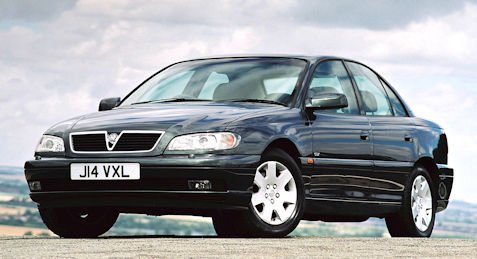
The Opel Omega B is a car from Opel, which was produced from early 1994 until mid-2003. This came as the successor to the original Omega A and in the UK as the Carlton now as the Vauxhall Omega.
On 29 April 1994 first appeared Omega B. The Omega B was now equipped with airbag system. The suspension was also strengthened. The base engine was also the previously installed four-cylinder engine with 2.0 l and 85 kW (116 hp), in addition to a 16-valve variant with 100 kW (136 hp). The previous straight-six gasoline engines were replaced by newly developed V6 engines. First there was the 2.5-liter with 125 kW (170 hp), also the 3.0-liter with 155 kW (211 hp) in the top model MV6.
As diesel there was initially the BMW-acquired 2.5 -Liter turbo diesel (inline six-cylinder) type M51-D25 with 96 kW (131 hp) instead of the 105 kW of the BMW 325 / 525tds. Then there was a 2.0-liter 16V direct-injection diesel engine with 74 kW (101 hp). The injection pump is driven on this engine with duplex timing chain, from there goes a single chain to the camshaft. Despite the 16 valves, it has only one camshaft, which drives the valves via low-friction roller rocker arms.
The new V6 engines had light alloy cylinder heads with four valves per cylinder. Added to this was the "Multiram system", which can vary the length of the intake in relation to the engine speed in several stages, which especially in the lower speed range provided for more torque. All engines in the Omega were installed longitudinally. The compact and short design of the V6 engines made them suitable for transverse installation in vehicles with front-wheel drive. Accordingly, the 2.5-l V6 was also offered in Vectra and Calibra.
Already in autumn 1994, the corrosion protection was improved and raised the hood in the rear area to reduce wiper flutter. Furthermore, the air conditioner was equipped with an interior coating evaporator, the control of the sunroof was improved and modified in the interior of the bracket for floor mats. Larger changes were also experienced by the gearboxes. For the large automatic transmission AR 35 (for the X30XE), the rear axle ratio was set from 1: 3.9 to 1: 3.7. The AR 25 transmission received a larger converter and the lockup clutch was modified for vehicles with the 2.5 TD engine. The manual transmission received vibration absorbers.
From the fall of 1995, new colours for painting, the electronically controlled air conditioning with sun sensor and a new radio generation were offered. The control of the central locking system and the anti-theft alarm system was now carried out by radio remote control instead of infrared. The variable wiper interval was adjusted by knurling wheel in the wiper lever. The engine room noise isolation, the front-seat and rear adjusters, the radio interference suppression of the automatic transmission control units and the heat output (via additional pump) have been improved. Torsion spring door brakes were used on the rear doors from now on. Other changes included the hybrid generator airbag system, the security locks, the cargo compartment cover of the caravan and the rear axle body assembly. In addition, a two-piece aluminium engine oil pan was introduced for the X20XEV engine, and the gearshift levers were cut by 25 mm on all models.
Since summer 1996, the steering wheel height adjustment, CD changer and steering wheel remote control have been offered as optional extras for the Omega. Side airbags and belt tensioners were standard equipment. The centre console received precious wood veneer, there was now a five-stage blower and the traction control with brake intervention was introduced. Other changes involved change of fuel hose material and better sealing of the exhaust system. From February 1997, a navigation system could be ordered.
Beginning in the fall of 1997, the dashboard received a continuous ventilation slot for the windscreen. The now fully upholstered headrests on the window seats could be folded forward and sunk in the caravan, the rear centre head restraint. The interior rearview mirror has been enlarged and the hinges and lock on the lid of the centre armrest have been improved. New versions have been introduced: the level control sensor, the anti-lock braking system 5.3 or 5.3 / TC, the instrument cluster with fog lamp and tail lamp control lamps and the cruise control unit.
In addition, clear-glass ellipsoid headlamps as standard as well as xenon lights were available as an option. A new radio system was available and the OnStar communication service was introduced. The clock could now set itself by RDS signal. For all vehicles, the large brake system has now always been installed. The 2.0-16V engine (X20XEV) received balancer shafts and intake system modifications to improve smoothness and noise levels. On the 3.0-l-24V engine (X30XE), the cylinder head, intake manifold and engine control unit were changed and the back pressure reduced by the rear silencer to increase performance and reduce noise. In addition, all automatic transmissions received an electromechanical selector lever lock.
From December 1997, the small 2.0-liter diesel engine with 74 kW could be purchased. Since February 1998, all models have been equipped with a third brake light, which is fitted with LEDs in the sedan and standard incandescent bulbs in the caravan. In addition, the traction control switch was moved over the radio and the immobilizer control unit was secured against removal from the ignition.
In August 1999, the Omega received a major facelift, the modified version was internally referred to as Omega B2. Both the front and the rear have been redesigned, the interior has been largely redesigned. Chrome strips accounted for the most part, but bumpers and sidebars were painted in body colour. There were new equipment lines, with the MV6 accounted for. The noblest variant called itself now "Executive". Included in this line was almost everything that had the offer list: leather upholstery, power seats, xenon light, cruise control, radio with CD changer and telephone. Surcharge for this equipment were almost only the sunroof and the metallic paint.
The Opel-Fix child seat safety system could now be ordered. The navigation system came now directly from Opel and was series in the Omega MV6. Again, a new improved radio system was offered and changed the load compartment cover on the caravan. The key got a changed case (rectangular rubber keys). All available petrol engines now use four-valve technology and the air conditioning was standard.
For the 2.5L V6 engine (X25XE), the rear axle ratio has been truncated and changed for all V6 timing belt geometry and material to minimize noise. In addition, there were changes in the oil circulation system.
From February 1999, an improved catalyst was installed. Likewise, from this point on the special model Edition 100 was offered. As described, a revised version of the Omega appeared in August 1999. As part of the facelift, the front end was provided with a V-shaped contoured bonnet, integrated grille and adapted to the new design clear glass headlights. The rear lights of the caravan model, the exterior mirrors (electrically folding) and the bumpers rear and front have been redesigned. By using thicker sheets in many places, the body rigidity could be increased. A new generation of hybrid airbags arrived for installation.
Other safety-related changes were the introduction of active headrests and a Quick Power brake booster. The previous information displays for radio and on-board computer were replaced by graphical displays - either in monochrome or in conjunction with a navigation telephone radio coloured. From now on, all offered radios were designed in double DIN size. Other changes in the interior concerned the seat cushion variants, fold-out pockets in the door panels and a completely fold-up armrest. The two-zone automatic climate control was standard.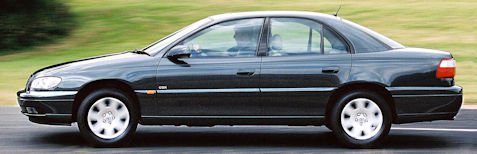
The 2.0-liter 16V engine (X20XEV) was eliminated and replaced with a 2.2-liter 16V engine. This received at the same time an improved electronic immobilizer. Opel now granted a 10-year rust-proof warranty.
With the revision also followed a new base engine with 106 kW (144 hp) from 2.2 litters of displacement, at the same time accounted for the two two-Liter machines. From autumn 2000, a so-called "over-omega" with a 5.7-liter V8 LS-1 with 228 kW (310 hp) was to be built again. But this was withdrawn a few weeks before the planned launch, because transmission problems could not be solved. The engine itself (engine code Y57XE) developed a maximum torque of 450 Nm. According to information, 32 production-ready Omega V8s were produced, which were used as test cars and still exist today at Opel.
Also from autumn 2000, a 2.6 -Liter engine with 132 kW (179 hp), which replaced the 2.5 V6, and a 2.2-l diesel with 88 kW (120 hp) was offered. For those who had waited in vain for a more powerful omega engine, Opel pushed in the spring of 2001, a 3.2-liter V6 with 160 kW (218 hp), which replaced the 3.0 -Liter and was only available with automatic transmission (except government vehicles).
The first common- rail diesel came in the summer of 2001 with an also purchased from BMW 2.5-liter inline six-cylinder M57 -D25. The throttled over the entire speed range by software engine provided 110 kW (150 hp) and 300 Nm instead of the 120 kW (163 hp) and 350 Nm of the BMW 525d.
All 6-cylinder models received rear brakes with ventilated 286 × 20-mm discs. An oil cooler for the transmission oil of the automatic models was introduced, likewise for these models the heat protection plate was enlarged. A heat-reflecting windscreen with seven metal vapor layers was installed. Silicate-free engine coolant as lifetime filling was used. The side indicators were now white, the fond cigarette lighter replaced by a 12-volt power outlet and the engine control unit OBD-2-capable.
In October 2000, the 2.5 V6 engine (X25XE) was replaced with the 2.6 V6 (Y26SE) and the 2.0-liter diesel engine (X20DTH) with a 2.2-liter diesel engine (Y22DTH). The 2.2 DTI with R 30 transmission got a self-adjusting clutch. In addition, the power steering was improved, which now offered greater support at idle speed. From February 2001, the 3.2-liter V6 engine (Y32SE) replaced the previous 3.0 V6 (X30XE).
From July 2001, the 2.5-liter diesel engine (Y25DT) purchased from BMW was installed and already declared as model year 2002. The 2.5 DTI was also available in conjunction with a five-speed automatic transmission (GM 5L40-E) to choose from. The DVD system Audio-Vision could be ordered as an option.
From December 2001, all six-cylinder models were delivered without extra charge with ESP. On June 24, 2003 ran a silver Omega B 3.2 V6 as the last vehicle of the model series in Russelsheim off the line. In nine years, 797,011. Copies.
At the end of June 2003, Opel discontinued the production of the Omega B. Thus, ended for the brand an era in the more upper middle-class segment, because the Omega was the last Opel of this magnitude in the classical construction method with front engine and rear wheel drive. The traditional design of the four-door notchback sedan was abandoned due to the lack of success in this segment. As a station wagon, the Omega was replaced by the Vectra C Caravan, which, like the Signum, had a 13 cm larger wheelbase than the Vectra sedan, positioning both models above it. With the model study Insignia Opel showed in the fall of 2003 another solution to follow the omega, which was discarded again. In addition to sedan and station wagon also other body variants were offered: As a sedan with extended wheelbase (Statesman / Caprice), as a four-wheel drive estate (Adventra), as a two- and four-door pickup (Ute / Crewman) and a two-door coupe Monaro, The Monaro was distributed in slightly modified form in America as Pontiac GTO and in England under the name Vauxhall Monaro. The coupe was only available with V8 engine. In 2006, the Holden models were replaced by new developments on the GM Zeta platform.
On the American market, the Omega was offered between the summer of 1996 and autumn 2001 as Cadillac Catera. Since this was also built in Russelsheim, it had the benefit from the good reputation of "Made in Germany". Externally, the Cadillac of the Opel differed mainly by a different grille, modified bumpers and modified rear lights and another centre console insert with integrated cassette radio and climate control via buttons or button switch. Technically, they were virtually identical. The Catera was only the 3.0 or later the 3.2-liter V6 used.
In Australia (under the brand name Holden), the Omega was built in a significantly modified form until the summer of 2006 with V6 and V8 engines. There this was not called Omega, but depending on the equipment Holden Commodore, Berlina or Calais.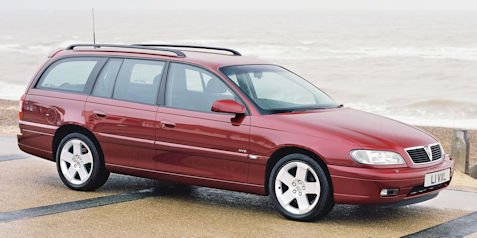
|
Featured
|
|
