
About
Technical
-
Petrol engine
model
engine type
capacity
Cylinders / Valves
Power
kW (hp) / min -1Max. Torque
(Nm at min -1 )construction time
1.8
Z18XE
1796 cm³
R 4 / 16V
90 (122) / 6000
167/3800
02 / 2003-05 / 2005
1.8
Z18XER
1796 cm³
R4 / 16V
103 (140) / 6300
175/3800
01 / 2006-07 / 2008
2.0 Turbo
Z20NET
1998 cm³
R4 / 16V
129 (175) / 5500
265 / 2050-3800
02 / 2003-07 / 2008
2.2 direct
Z22YH
2198 cm ³
R4 / 16V
114 (155) / 5600
220/3800
02 / 2003-07 / 2008
2.8 V6 Turbo
Z28NEL
2792 cc
V 6 / 24V
169 (230) / 5500
330 / 1800-4500
06 / 2005-06 / 2006
2.8 V6 Turbo
Z28NET
2792 cc
V6 / 24V
184 (250) / 5500
350 / 1800-4500
06 / 2006-07 / 2008
3.2 V6
Z32SE
3175 cc
V6 / 24V
155 (211) / 6200
300/4000
02 / 2003-05 / 2005
Diesel
model
engine type
capacity
Cylinders / Valves
power
Max. Torque
(Nm at min -1 )construction time
1.9 CDTI
Z19DTL engines
1910 cm³
R4 / 8V
74 kW (100 hp)
260 / 1700-2500
06 / 2005-07 / 2008
1.9 CDTI
Z19DT
1910 cm³
R4 / 8V
88 kW (120 hp)
280 / 2000-2750
03 / 2004-07 / 2008
1.9 CDTI
Z19DTH
1910 cm³
R4 / 16V
110 kW (150 hp)
320 / 2000-2750
03 / 2004-07 / 2008
2.0 DTI
Y20DTH
1995 cm³
R4 / 16V
74 kW (100 hp)
230 / 1500-2500
02 / 2003-11 / 2004
2.2 DTI
Y22DTR
2172 cc
R4 / 16V
92 kW (125 hp)
280 / 1500-2500
02 / 2003-11 / 2004
3.0 V6 CDTI
Y30DT
2958 cc
V6 / 24V
130 kW (177 hp)
370 / 1900-2800
02 / 2003-05 / 2005
3.0 V6 CDTI
Z30DT
2958 cc
V6 / 24V
135 kW (184 hp)
400 / 1900-2700
06 / 2005-07 / 2008
Note:
All engines and full specifications available for registered users© Motor-car.net
Manuals
Vauxhall Opel Signum
 |
|
|
Production period: |
2003 to 2008 |
|
Class: |
Motor Car |
|
Body versions: |
hatchback |
|
Engines: |
|
|
Length: |
4636-4651 mm |
|
Width: |
1798 mm |
|
Height: |
1466 mm |
|
Wheelbase: |
2830 mm |
|
Curb weight: |
1495-1715 kg |
|
successor |
Opel Insignia A |
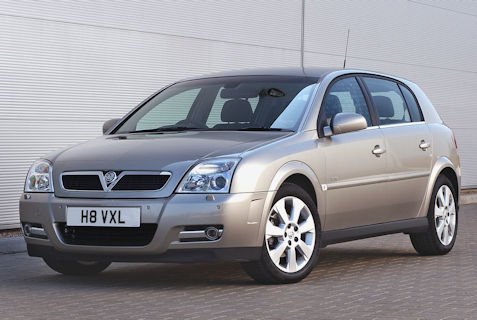
The Opel Signum was a vehicle of the car manufacturer Opel, which was produced from February 2003 to July 2008. It was based on the platform of the Vectra C. Its assembly took place in the Opel main plant Rüsselsheim. With comparable overall length the Signum offers more space in the rear than the Vectra sedan due to the longer wheelbase of the Vectra Caravan (estate version). The ratio of wheelbase to total length is 61 percent. These features should lift the Signum as a hatchback version of the Vectra sedans and position it independently as a top model of Opel. Accordingly, the signum was marketed separately from the Vectra models.
With Improved driving dynamics, comfort and safety the design of the four-link rear suspension also helped to reduce friction, which consequently enables easier suspension compression. This was achieved with the help of a total of six new bushes in the wishbones. With additional intermediate plates, the bushes enable a noticeable improvement in the movement of the axle – which leads to considerably more smoothness, especially in the case of one-sided suspension compression. The next stage of the chassis modifications involved the alignment of the shock absorbers to the lower breakaway torque of the springs, which results in more direct suspension response. Chassis specialists thereby achieved increased comfort, without compromising agile handling.
New response settings of the electro-hydraulic rack-and-pinion power steering, which is regulated by steering and driving speed, in addition, the steering effort correspondingly increases in larger steering angles, giving improved road contact. In contrast, the power steering is increased at lower speeds, enabling easier manoeuvring into narrow parking space. The adaptive IDS-plus chassis with electronic Continuous Damping Control (CDC) ensures a constant optimum balance between driving comfort and stability. The electronic CDC is based on four shock absorbers controlled by solenoid valves, which precisely and continuously adjust the shock absorbers. IDS-plus networks all dynamic driving systems such as ESP, traction control, ABS and CDC via CANbus (Controller Area Network), forming an integrated chassis control system.
This networking forms the basis for optimised handling performance in terms of comfort, safety and dynamics on an even higher level. Calibrated damper adjustment improves steering performance, allowing later and thereby significantly more sensitive ESP activation. When braking, the system adjusts the shock absorber settings to adapt to the road surface for optimal ABS control, which improves braking characteristics, especially on bumpy roads. Thanks to minimized wheel vibrations, braking distance on roads with loose or uneven surfaces is reduced by up to five percent – a decisive advantage, considering the deteriorating quality of roads. In addition, IDS-plus enables a measurable increase in safety when individual wheels are on a different type of surface, or on wet roads, ice or snow.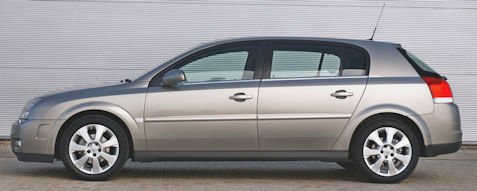
The IDS-plus chassis system also offers the choice of a tighter, even more agile setup via a button. The Sport Switch function not only regulates damper characteristics, it also enables more direct throttle pedal response and the map-controlled electro-hydraulic power steering switches to a more sporty, higher steering effort level. In conjunction with automatic transmissions, the gearshift points are set at higher rpm to allow for a sportier driving style.
Redesigned side sills with shortened contours mark a further difference in the Signum's styling. Together with the short rear overhang and wide C-pillar a long wheelbase of 2.83 meters. The sills are now colour-keyed Pronounced wheel arches, large door handles and a high waistline. Matched to this dynamic profile is the wide selection of wheels ranging from 16 up to 19-inches.
Body: high-strength materials, crash-optimised structure has rigid passenger cells that provide a large survival area in all accident scenarios. In the event of a collision, the energy is absorbed by a number of main load paths, high-strength cross bars, as well as predefined deformation zones behind and on the side of the extremely rigid passenger cell. In a frontal crash, the impact is absorbed by the frame structure, the front axle subframe and the wheelarch braces, while in a rear end collision, the energy is absorbed by the frame under the passenger cell and directed over the highly stable C and D-pillars as well as the wheelarches into the roof structure. The design and construction of the doors minimise the consequences of a side collision thanks to integrated steel barriers and additional high-absorption cushioning elements,
B-pillars made of high-strength boron alloy steel, a B-pillar/roof cross member structure made of high-strength PHS (Press Hardened Steel) as well as large, stable door sills. Active head restraints now also for rear seats Standard safety equipment includes front and side airbags, head curtain airbags in front and rear, three-point safety belts for all seats, seat belt pretensioners in front (also in the rear of the Signum with sliding rear seats), belt-force limiters in front and rear, as well as height-adjustable safety belt pivot points in front and rear.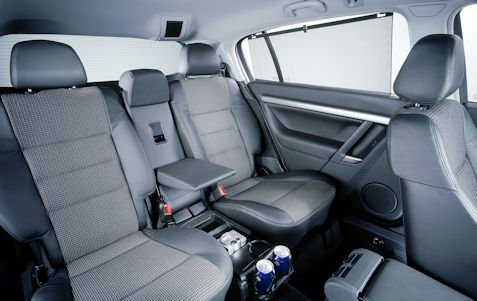
The interior of the Signum also in details such as the attractive leather-look grain in the top section of the instrument panel that flows into the door trim. The cockpit makes a lighter, more modern impression, thanks to the new contours of the instrument panel, the rounded corners of air vents and the chrome-edged controls on certain models inserts in wood, aluminium or carbon-look. All models have three-spoke steering wheels, that is designed to offer more comfort from the driving seat. The two 130 mm slidable and fully retractable single rear seats, whose backrest angle is also individually adjustable by 30 °, should provide the comfort of a comfortable sedan in combination with the benefits of a station wagon.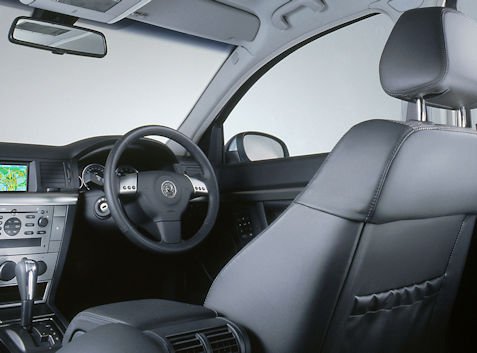
The interior is 8 inches longer than the Vectra sedans. The seat surface of the central rear seat can be folded down and then provides various storage options or is the basis for the optional travel assistant - a cooler with two folding table, tray, cup holders, two 12-volt power outlets and remote control for the optional Twin-Audio - System. The middle back seat is released despite a full three-point belt due to the low internal height only for people up to 1.75 m height. Vehicles without a sliding lifting roof are equipped with a centre console mounted on the headliner. Depending on the position of the rear seats, the trunk volume can be varied from 365 to 550 Liters (up to the height of the luggage compartment cover).
After the smaller facelift in March 2004, the vehicle was visually adapted to the current design of the brand as part of the larger facelift in June 2005. Due to modified bumpers, the vehicle length grew from 4636 mm to 4651 mm.
Characteristic features of these models are the redesigned front end, the interior enhanced by chrome trim and new decorative trim, and the with the appearance of the revised Signum the 3.2-liter six-cylinder gasoline engine was no longer available. The 2.2-liter gasoline direct injection engine received a new 6-speed manual transmission, but was still available on request with the familiar 5-speed manual transmission.
As of January 2006, a modernized 1.8-liter four-cylinder gasoline engine with 103 kW was available. On request, this engine was also delivered with an automated five-speed manual transmission (Easytronic). A 6-speed automatic transmission for the other engines was also offered. The 2.2-liter gasoline direct injection engine was optionally available only with a five-speed automatic transmission.
Engines
The engine range is not fundamentally different from that of the Vectra C - with the exception of the 1.6-liter four-cylinder gasoline engine and the OPC engines, which were not available for the Signum. The Signum Turbo S was the flagship model and was offered with a 2.8-liter six-cylinder engine with 184 kW (250 hp) performance. The 1.9-liter diesel engines were jointly by GM Powertrain and Fiat developed and later as standard, and initially available with a diesel particulate filter fitted.
After the completion of the joint venture, General Motors and Fiat share the rights to the 1.9-liter engines, the production was based on long-term contracts continue at Fiat. The 2.0 and 2.2-liter diesel, however, were an Opel own development, which were not offered ex works with a diesel particulate filter. The V6 diesel initially with 130 kW (177 hp, from June 2005: 135 kW / 184 hp) came from Isuzu.
A range of petrol and diesel engines are available the 230 PS V6 turbo petrol engine with a top speed of 155mph (electronically limited), but also to the advanced CDTi diesel engines. The power output of the 3.0-litre V6 CDTi diesel with increased power by 7PS to 184PS.
The top-of-the-range engine is the 2.8-litre petrol, newly developed by GM. The turbo unit shares many of these features with the two V6 naturally aspirated engines (2.8 and 3.6-litre), which are part of the new fully aluminium range used worldwide by General Motors. As well as a classic cylinder angle of 60 degrees and overhead camshafts driven by dual chains, common features with the 24-valve unit include variable valve control and a four-bearing crankshaft made from micro-alloyed forged steel. The pistons are equipped with hard anodized ring slots for a longer life cycle, run-in cast-iron bushes and are oil-spray cooled. Sintered connecting rods, exhaust valves filled with sodium for better cooling, and the oil sump, which is especially rigid due to its die-cast aluminium construction, also represent state-of-the-art technology twin-scroll turbocharger and variable camshaft control.
The twin-scroll turbocharger is reserved for the 9.5:1 compression ratio top-of-the range engine. The intercooler system, which is centrally mounted above the transmission, has an integrated waste gate and supplies the engine with a maximum of 0.6 bar excess pressure. The turbine wheel is made of a high-quality special steel composition. Due to its twin-scroll design, the turbine is fed simultaneously from both rows of cylinders. Separate channels – one for each bank of cylinders – separate the exhaust gas pulses. On the one hand, the operating principle minimizes turbocharger energy losses and, on the other hand, it has a positive effect on the exhaust gas flow and efficiency electronically controlled, hydraulic phasing of the inlet camshafts. They can be adjusted over a range of 50 degrees with respect to the crankshaft, in order to optimally vary the valve timing and thus optimise the charge cycle to suit the engine load and speed. Like the outlet shafts, the inlet shafts are also made from high-strength aluminium. The 2.8-litre unit provides 90 percent of its 330 Nm maximum torque at only 1500 rpm. The 0-60mph sprint takes only 7.2 seconds.
Automatic transmission with additional manual function, all engines have a six-speed manual gearbox as standard. For the more powerful variants, a five-speed automatic (2.2 Direct) or a six-speed automatic with Active Select function (2.8 V6 Turbo, 150 hp 1.9 CDTi and 3.0 V6 CDTi) are also available. In addition to the fully-automatic mode, the transmission gives the driver the option of changing gear manually in a second shifting slot by simply tapping the gearshift lever.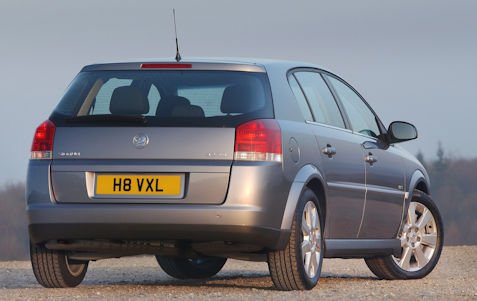
|
Featured
|
|
