
About
Technical
-
Dimensions:
Minivan, 5 doors, 5 seats
wheelbase 278 cm
track 154/154 cm
turning circle 11.6 m
luggage capacity 440–1740 dm³
length 446 cm
width 179 cm
height 162 cm.
60-liter fuel tank
205/60 R16 tires
6.5 J rims.
curb weight from 1430 kg
max. permissible weight 2125 kg.
Engine 1.6L
1ZR-FAE
4 valves per cylinder
dual overhead camshafts
chain-driven/VVT
aluminum cylinder head
5-bearing crankshaft
4.2 L oil capacity
port fuel injection.
4-cylinder, inline
1598 cc
compression ratio 10.7:1
97 kW/132 hp at 6400 rpm
160 Nm at 4400 rpm
95 RON fuel.
Engine design:
Drivetrain
front-wheel drive
ESP
6-speed manual transmission
gear ratios: 1st 3.54, 2nd 1.91, 3rd 1.39, 4th 1.03, 5th 0.88, 6th 0.74, reverse 3.33
final drive ratio 4.56.
Chassis:
Unibody construction
front: struts, control arms; rear: torsion-beam axle; coil springs front and rear
rear stabilizer bar.Brakes:
Four-wheel disc brakes (ventilated at the front)
disc diameter: 29.5 cm front, 29.7 cm rear
handbrake acts on rear wheels
ABS
rack-and-pinion steering
electric. Power steeringverso
1.6 Valvematic
1.8 Valvematic
1.6 D-4D
Construction period:
04 / 2009-06 / 2018
02 / 2014-06 / 2018
Engine Type:
Four-cylinder gasoline engine in serial construction with Valvematic
Four-cylinder in-line diesel engine with common-rail injection , turbocharger
displacement:
1598 cc
1798 cc
1598 cc
Max. Power at min -1 :
97 kW (132 hp) / 6400
108 kW (147 hp) / 6400
82 kW (112 hp) / 4000
Max. Torque at min -1 :
160 Nm / 4400
180 Nm / 4000
270 Nm / 1750-2225
Gearbox, standard:
6-speed manual transmission
Gear, optional:
-
continuously variable transmission
-
Acceleration, 0-100 km / h:
11.7 s
10,4 [11,1] s
12.7 s
maximum speed:
185 km / h
190 [185] km / h
180 km / h
Fuel consumption
(according to EEC directive,
combined on 100 km):6,7 l super
6.9 [7.0] l Super
4.5 l diesel
CO 2 emission, combined:
158 g / km
162 [164] g / km
119 g / km
Emission standard according to EU classification:
Euro 4
Euro 6
Values in square brackets apply to the continuously variable transmission
verso
2.0 D-4D
2.0 D-4D
2.2 D-4D
2.2 D-CAT
Construction period:
04 / 2009-01 / 2013
01 / 2013-02 / 2014
04 / 2009-05 / 2015
04 / 2009-05 / 2015
Engine Type:
Four-cylinder in-line diesel engine with common-rail injection , turbocharger
displacement:
1998 cm³
2231 cm³
Max. Power at min -1 :
93 kW (126 hp) / 3600
91 kW (124 hp) / 3600
110 kW (150 hp) / 3600
130 kW (177 hp) / 3600
Max. Torque at min -1 :
310 Nm / 1800-2400
310 Nm / 1600-2400
340 Nm / 2000-2800
400 Nm / 2000-2800
Gearbox, standard:
6-speed manual transmission
6-speed automatic transmission
6-speed manual transmission
Gear, optional:
-
Acceleration, 0-100 km / h:
11.3 s
11.3 s
10.1 s
8.7 s
maximum speed:
185 km / h
195 km / h
210 km / h
Fuel consumption
(according to EEC directive,
combined on 100 km):5.6 liters of diesel
4.9 liters of diesel
6.8 l diesel
6.0 l diesel
CO 2 emission, combined:
146 g / km
129 g / km
178 g / km
159 g / km
Emission standard according to EU classification:
5 euro
Values in square brackets apply to the continuously variable transmission
© Motor-car.net
Manuals
Toyota Verso
|
|
|
|
Production period: |
2009 to 2018 |
|
Class : |
Motor Car |
|
Body versions : |
station wagon |
|
Engines: |
Gasoline : 1.6-1.8 Liters |
|
Length: |
4460 mm |
|
Width: |
1790 mm |
|
Height: |
1620-1630 mm |
|
Wheelbase : |
2780 mm |
|
Curb weight : |
1505-1735 kg |
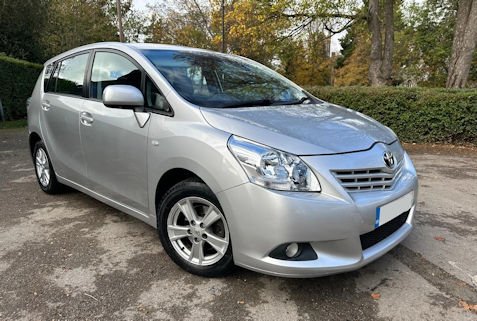
The Toyota Verso is a van that was produced by Toyota between spring 2009 and summer 2018 . It is based on the platform of the Toyota Corolla and replaced in the model range both the Toyota Corolla Spacio / Corolla Verso and the Toyota Avensis Verso . Depending on the equipment variant, it can accommodate up to seven people.
History
The Toyota Verso was presented in March 2009 at the Geneva Motor Show . The design is adapted to the current Toyota models such as Avensis or iQ .The dimensions and the wheelbase are only slightly larger than the Toyota Corolla Spacio / Verso. The front has a louvred grille, other headlights and air intakes and a more contoured bonnet. The front fenders are highlighted even more, while the side windows and the roof contour remained virtually unchanged. The side view is crossed by a conspicuous, curved light edge , which begins at the front sill and ends in the rear tearing edge on the roof. Like the predecessor model, the rear features silvery taillights and a wider rear window.
Inside, the verso is based on the Toyota Avensis . Unusually arranged are the middle air vents and the now cantered placed on the driver-oriented instruments.
In early summer 2013, a revised version of the Verso came with a visually significantly revised and modernized front end on the market. This is now based on that of the Auris of the second generation. The rear, however, was only slightly modified, technically the verso remained largely unchanged. Since the beginning of 2014, a 112 hp 1.6-liter turbo diesel complements the model range. The four-cylinder engine comes from BMW and is manufactured in their factory in Steyr. Since July 2018, the Verso of Toyota is no longer offered.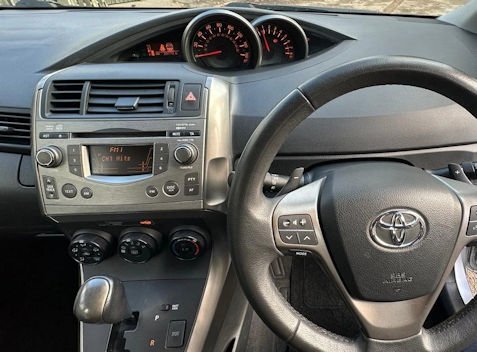
|
Featured
|
|
