
Fiat Uno Turbo
 |
|
|
Manufacturer |
FIAT |
|
Class |
Sports Car |
|
Engines |
1.3-1.4L |
|
Length |
3644mm (First series) |
|
Width |
1560 mm |
|
Height |
1370mm (First series) |
|
Step |
2360 mm |
|
Mass |
845 (First series) kg |
|
Style |
Giorgetto Giugiaro |
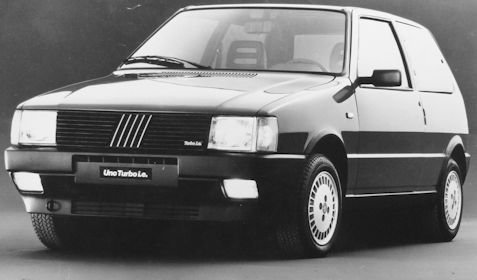
The Fiat Uno Turbo ie was the sports version of the Fiat Uno, produced from the mid 198s to the mid-1990s so classed as an original Hot Hatch.
The Uno Turbo IE was launched to enter the small sports car market, where the Renault 5 GT Turbo, Peugeot 205 GTi, and Golf GTI were notorious at the time.
In a short time, improvements were made to the engine of the basic version. In fact, the engine was equipped with two different control units: one for Bosch LE-Jetronic Multipoint electronic injection and one for the Magneti Marelli Micro plex MED electronic ignition. The turbocharger was a Japanese IHI VL2, water cooled with a maximum pressure of 0.55 bar, equipped with Intercooler to lower the temperature of the air entering the cylinders; in addition, an oil radiator was installed next to the turbocharger behind the front bumper.
The 1301 cc turbocharged engine (engine abbreviation 146A2.000), which in the naturally aspirated version from the Uno 70 SX had 48 kW / 65 HP, in this supercharged variant was now revised in the head and in the water passages. It should be noted that the monobloc had actually been specially developed for the Uno Turbo and was derived from the original engine of the Fiat 128 and the 1116 cc Ritmo but with a stroke of 1598 cc mounted on Ritmo 105TC. The engine was capable of delivering 77 kW (105 hp) at 5750 rpm and a maximum torque of 147 Nm at 3200 rpm with remarkable performances with an acceleration 0-100 km / h in less than 9 seconds. Even the alloy wheels were dedicated to the IE Turbo: with a 13-inch full diamond-coated with 5.5-inch channel, they accommodated 175/60 tires and hubcap cups with the Abarth scorpion logo on a red background.
The First series (from April 1985 to 1989)
On the road, the new Fiat sports car has high roadholding, performance and fuel consumption with the adoption of the turbo, thanks to the electronic injection. The 5-speed gearbox, derived from the Fiat Ritmo 105 TC, and the brake system is equipped with disc brakes front ventilated 240 mm in diameter and rear disc 227 mm.
Outside, the car now shows a redesigned front bumper with standard fog lights and two additional slots for cooling the engine oil and charge air (intercooler). The car is fitted with wheel arches and side skirts identical to those of the SX version. On the back hatchback an integrated spoiler, all made of fiberglass. The exhaust tip is chrome-plated. Inside, the black velvet seats with the Fiat emblem (the 5 red bars) stand out longitudinally on three rows per seat. The backrest of the seat and the rounded part of the dashboard in front of the passenger and of a soft plastic material with small squares printed on the surface. The floor carpet is red without footrest and long pile type, the black safety belts, the interior mirror with red liquid crystal clock. A rare accessory available only on this version is the panel screen at the centre of the instrument panel with the lights set to indicate any anomalies to the cooling system, lubrication, open door warning light, extinguished bulbs. The 1985 model is recognizable by the absence of the adhesive strips on the side and on the tailgate and the details such as the trim and mirrors not matching the exterior.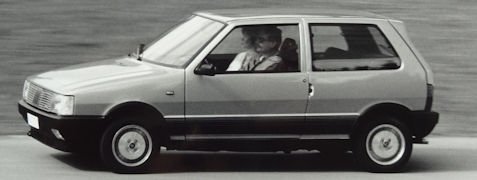
In 1986 with the upgrade of the range comes the model year 86 practically identical to the initial version, but with the addition of external details in matching plastic and adhesive strips in the side and rear hatch with the words Turbo IE on the first two. The red-light digital clock disappears to make way for another green liquid-crystal watch, just as the control panel option is eliminated, but the new and spectacular digital picture produced by the Japanese Nippon-Seiki begins. This option replaces the classic analogue instruments and displays the various information on amber-coloured light bar displays. A footrest is added to the carpet which maintains the same features as the previous one.
For the model year 1988 the most important restyling of the first series. The most innovative option was the Antiskid: it was a braking system with anti-lock, similar to ABS but simpler (and less efficient), produced by the English AP Lockheed; this system only acted on the front wheels. For this version, special dark gray alloy wheels were provided, with only the outer diamond part, and new interior linings. The fabric was changing, now no longer the delicate black velvet with the five red bars of the Fiat logo, but a much more resistant classic fabric, style with Turbo IE written in the centre of the back of the front seats. Also new are the red belts with black piping (the same as those of the Lancia Delta HF Integrale). The steering wheel is now covered in leather and the carpet remains red, but with shorter fur and a more elegant appearance. The model adopts the new gearbox with decidedly improved robustness. The new model also stands out for the different adhesive strips on the newly designed and thinner sides. The decal disappears from the back door, while the door covers and the contours of the windshield and rear window in opaque black. Standard equipped with: fog lights, H4 halogen headlights, additional wheel arches, under door skirts, front wheel arch linings (this only for versions equipped with antiskid module). The main options were: metallic paint, sunroof, central locking, electric windows. As for the next second series, the petrol tank is composed of two tanks connected to each other: one under the car bed, 42 litres, with an additional one inside the right rear wheel compartment of 6 Liters capacity, for a total of 48 litres of fuel.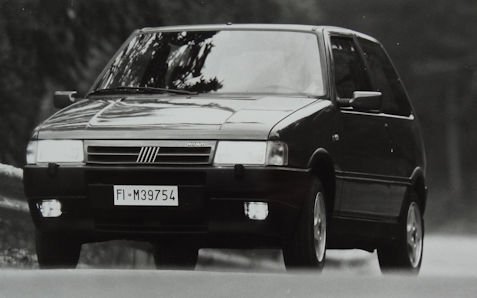
Second series (Built September 1989 until December 1993)
In September 1989 FIAT updates the Uno with an important restyling, to keep its success alive and the new Uno Turbo now has a new engine of 1372 cc (146A8.000) inherited as a Fiat Type 1.4 structure and derived from the previous 1301 simply increasing the stroke by a few mm, the head is also modified with a different compression ratio, a significant increase in power now has 85 kW (116 hp). The maximum speed of this version reaches 205 km / h. The turbocharger is also new, this time an improved Garrett T2 is used with a maximum pressure of 0.8 bar that starts operating very early, already around 2500 rpm.
For the German and Swiss market, as the anti-pollution regulations were already in force, it was marketed as already happened for some specimens of the first series, a catalysed version of the 1301 cc (mot.146A2.246) this model took the name of Uno Turbo, was equipped with a catalytic converter and had 101 HP / 74 kW (191 km / h and 9.1 seconds in the 0-100); this is the less powerful version built.
The interior of the second series was equipped with a more modern and practical as for the rest of the range, as well as a better quality and solidity perceived as well as outside (better finishes and assemblies) the more evident details of this new Turbo ie were the black and Gray checkered seats, and the Momo three-spoke leather steering wheel.
The instrument panel as well as that of the first series, both analogical and digital, included 7 instruments enclosed in the dashboard: speedometer with full scale at 240 km / h with total and partial odometer, petrol level, electronic rev counter with full scale 8000 rpm range cooling water temperature thermometer, thermometer and engine oil pressure gauge, boost pressure with full scale at 1 bar.
Outside the customization was always sporty but more graceful and less striking than the first series: the resin hatch with spoiler disappears, there are new bumper shields (front with additional air intake and fog lights, the rear with integrated spoiler and stone finisher sides) both adorned with a red line along their width, the under door skirts are personalized with a red thread that ideally joins the sides of the bumpers, and the word "Turbo ie" in the area of the rear wheel adopts a new graphic of the characters that compose it. The rear lights are exclusive to this version and have the transparent area of the direction indicator and the reversing lights crossed horizontally by red lines that give it a more modern and sporty mark. It is not uncommon to come across some of these lighthouses which instead of having red lines present them white, in practice for some problem in the first period of production within a few years the red fades almost autonomously becoming white and giving rise to this particular look.
Also new are the sports design wheels, now however with 4 spokes (some called them "ventolini" instead of their design) with measures that are always the same, 5.5J13 - ET42.5, as well as the 175/60 tires. Until the advent of the Racing version, the rims were supplied in a completely diamond-cut version, subsequently to reduce costs they were offered in a silver-painted version.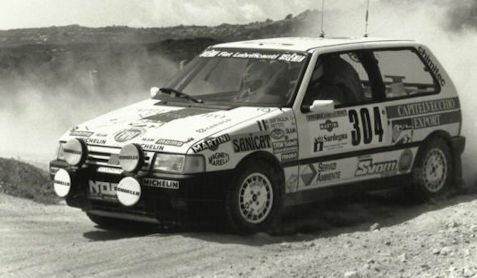
Related
Technical
-
First series (Phase 1)
Engine:
Front-mounted transverse four-cylinder with alloy head
belt-driven ohc
Marelli Microplex ignition
Bosch LE2 fuel injection, and IHI water-cooled turbocharger
Bore 80.5 mm, stroke 63.8 mm
capacity 1299 cc
Power 105 bhp (77 kW) at 5750 rpm
torque 108 1b ft (149 Nm) at 3200 rpm
Compression 7.65-to-l.
Turbo boost pressure 9.0 psi (0.62 bar).
knock sensor,
thermostatically controlled oil cooler
sodium-cooled exhaust valves, and Ni resist cast iron exhaust manifold
Fuel consumption at constant 75 mph (120 km/h) ; 37,2 mpgTransmission:
Front-wheel drive
five-speed manual gearbox NO automatic option
Top gear speed at 1000 rpm: 20,0 mph (32.2 km/h)Suspension:
Front, independent MacPherson struts, anti-roll bar
Rear, independent, torsion beam axle on semi-trailing arms
coil springs and telescopic dampers
anti-roll bar,Steering:
Rack and pinion
Power assistance; not availableBrakes:
Discs front and rear
servo-assistedDimensions;
Length 143,5 in (3644 mm)
width 61.0 in (1549 mm)
height 56.4 in (1432 mm)
wheelbase 93 in (2362 mm)Tyres: 175/60 HR 13
Fuel tank: 11.0 Imp. gall (50 litres)
Unladen weight: 1274 1b (576 kg)
Fuel consumption at constant 75 mph (120 km/h) ; 37,2 mpg
© Motor car History
Service
-
Service checks and adjustments
S1 1.3L
Valve clearance -INLET O,40 cold
vatve clearance -EXHAUST O,50 cold
Oil pressure -3.4-4.9 Bar
Engine oil grade - SAE 15w/30 semi-synthetic
Manual gearbox oil - 75w/90 2.4 litres
Brake fluid Type - DOT 3/4S2 1.4L
Valve clearance -INLET O.35-O.45 cold
valve clearance -EXHAUST O.45-0.55 cold-Note: Advanced Specifications and Repair Manuals available for registered users-
© Motor car History

