
Fiat Palio
|
|
|
|
Manufacturer |
FIAT |
|
Class |
Motor Car |
|
Main type |
Sedan |
|
Other versions |
Weekend; Locker |
|
Production |
from 1996 to 2017 |
|
Style |
Giorgetto Giugiaro |
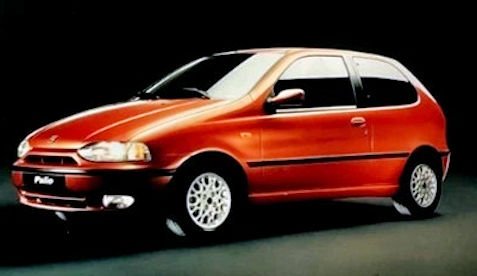
The Fiat Palio is a car produced by the FIAT Turin car manufacturer. Presented in 1996, it is, together with the three-volume sedans Siena and Albea (and in China in 2007 by Fiat Perla), the " world car " of FIAT, marketed in developing countries as: Latin America, Asia and Africa.
Production of this model began in 1996 and is still produced in many countries, such as Brazil, India, China, Turkey, South Africa, Morocco and Russia. It is sold in various versions, including a family version (the Weekend), and in a 3- door or 5- door sedan version. Great success in Brazil where it is also marketed with the 1.8 Flex engine, which allows a separate or combined use of petrol and alcohol.
The launch took place in 1996 in Brazil as a 178 project in four versions including a pick-up (Fiat Strada). The chassis was studied on the basis of that of the European Fiat Uno, with various improvements such as structural stiffening and suspension modifications (in the Weekend version, instead of the twisted deck layout adopted as by the One from the Saloon version of the Palio, the one with drawn arms was adopted used by the Point). For the Weekend model, the engines available in Italy were two multipoint electronic fuel injectors, a turbodiesel and an aspirated diesel:
Shortly after launch, production also began in the Argentinean factories, followed in 1997 by those in Venezuela, Poland and Morocco. Later the Turkish, South African, Egyptian and Chinese establishments were joined in the construction of this model, the latter in 2002. It was also imported and sold in Italy.
In 2001 the first restyling of the car took place, the new design of which was due to Giorgetto Giugiaro: with the latter, numerous new versions were launched with different engines based on the country of marketing. Prominent, for example, a sports version dedicated to the Turkish market with a 120 hp engine. Furthermore, the Turbodiesel version abandoned the old and robust 1.7 pre-chamber to make room for the newer and more efficient 80 hp JTD produced on the solid and well-tested 1.910 cm³ base. The petrol engine department was further updated with the introduction of the 1.2 Fire 16-valve 80 HP which was placed between the 8-valve version of the same Fire and the more powerful and complete 1.6 16-valve with 103 HP. Special attention was also paid to the automotive safety sector with the introduction of airbags and ABS. Another innovation is the inclusion in the range of models with automatic transmission.
From this version the export to various markets was interrupted, including Italy where only the Weekend version remained in the price list until 2004 (and where the car had had some success, especially in the family version). A second update, again due to Giugiaro, has taken up some stylistic themes already present in the sisters Punto and Stilo without, however, distorting their initial form. News also in the engines, especially in the Brazilian market where the Flex version has undergone a good increase in power. With this version, Fiat celebrated in 2006 the achievement of 2 million Palio produced. In 2008 the car's production amounted to over 100,000 units.
In 2005, Fiat launched the Palio 1.8R on the Brazilian market. This version had a sportier and more aerodynamic design that implemented a new body-kit, a new spoiler rear and wheels alloy covered with tires 185/60. On the body were applied the airbrush sports and implantation lights has been changed. The propeller installed is a 1.8 Flex Fuel capable of being used with petrol, alcohol or a mixture of both. It delivers a power of 115 hp, which allows the car to accelerate from 0 to 100 km / h in 9.2 seconds. The interiors are sporty with a digital control panel.
This last model has taken over the style of the Grande Punto grille, but it does not completely replace the previous model which is still marketed under the name "Palio Fire Flex”. The 2007 Model has been marketed, since 2008, together with the three-volume sister Fiat Siena with the initials "2009", and just in 2008 the Palio range is completed with the Station Wagon version (called Week End) and the Crossover SUV version (called Locker). The two new versions of the Palio share the front with the Siena. Basically, the Fiat World car range is complete with a two-volume sedan (Palio), three-volume (Siena) and Station Wagon (Palio Week End, from which the Palio Loker derives).
At the end of 2011, the second completely new generation was presented, developed on the new long-wheelbase Economy platform already adopted by the new Uno presented in 2010. The project for the new Palio (code 326) has been developed since the end of the 2000s: designed by the Turin style centre and engineered by the research and development centre in Brazil. A great novelty is the new base platform, the adoption of a simple and tested mechanical layout and the latest-generation engines of the Fire EVO and Ector family. The bodywork is proposed only in the 5-door variant, the 3-door version is not foreseen while the station wagon version will be introduced later according to the design plans of the house. Structural rigidity increases by 35% and new materials are adopted for the construction of the bodywork in addition to improving sound insulation and new production processes.
Stylistically, the new Palio takes up the design introduced with the Punto Evo as the integrated brand with a Fiat 500- style chrome Mustache, browned calendar and rounded bumpers, while the tail lights are introduced in the tail. Even the passenger compartment is more spacious than the previous series: 5 seats, a more modern and rounded dashboard made of higher quality plastics than the old series, although they still remain aligned with the target of the economic segment car. New more fashionable finishes and coloured inserts.
The length of the car is 3.79 m with 1.67 m of width, 1.49 m in height and with a wheelbase of 2.42 meters. The total mass of the car decreases by 15% compared to the previous series thanks to the adoption of new light alloys for the construction of the bodywork. Among the safety devices they are adopted 4 airbags, ABS with EBD and brake system consists of disc brakes ventilated at ' front axle and drum brakes at the rear axle. The suspensions they are composed of a front MacPherson architecture and interconnected rear bridge. The engine range consists of the revamped 1.0 Fire Evo Flex four-cylinder eight-valve engine delivers 75 hp in petrol operation and 77 hp in ethanol operation. Next to the 1.0 is the 1.4 Fire Evo Flex with 87 or 90 HP and the more powerful 1.6 E. Torq Flex 16 valves of the Palio Sporting at the top of the range with its 119 hp. The gearbox is a 5-speed manual with the option of the Dualogic 6-speed robot.
Production of the Palio ended in Brazil in 2017.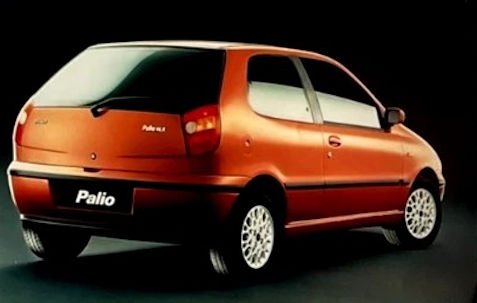
Related
Technical
-
Dimensions/weight :
wheelbase 236 cm
track 139/138 cm
ground clearance 14 cm
luggage capacity 280 dm³
length 374 cm
width 161 cm
height 145 cm.
48 L fuel tank
tires 145 R 12, 155 R 13, 175/70 R 13
rims 4 J, 5 J.
sedan, 3/5 doors
5 seats
curb weight from 890 kg, max. 1305 kg.Transmission:
(to front wheels).
5-speed gearbox
1.0L 1st 4.09; 2nd 2.24; 3rd 1.52;4th 1.16; 5th 0.97; Rev. 3.91
1.7L 1st 3.91; 2nd 2.24; 3rd 1.45; 4th 1.03; 5th 0.8; Rev 3.91; final drive 3.77.
final drive 4.36.Chassis:
Unitary body with rear subframe
front: struts and triangular wishbones, anti-roll bar
rear: trailing arms; front/rear: coil springs, telescopic dampers.Brakes
front discs, rear drums, front disc diameter. 24 cm
handbrake acting on rear wheels
Steering
rack-and-pinion steering
power steering optional
turning circle 10.4 mEngine: 1.0L 61 hp
Fuel injection
inline-4 (76x54.8 mm),
994 cc
compression 9.35:1
45 kW (61 hp) at6000 rpm, 45.2 kW/L (61.5 hp/L); 79 Nm(8.1 mkp) at 3000 rpm
92 RON.
1 overhead camshaft (timing belt)
Light-alloy cylinder head
5-bearing crankshaft
oil capacity 3.5 L
electronic injection
Magneti-Marelli, MPI IG7.
top speed 152 km/h
weight-to-power ratio 19.8 kg/kW (14.6 kg/hp)
fuel consumption (factory) 5.9/7.8 1/100 km.
Battery 32/50 Ah
alternator 65 A
water cooling, capacity 6.6 L.1.7 Turbodiesel
inline-4 (82.6x79.2mm)
1698 cc
compression 20.3:1
diesel.Engine (mfr.): designation 176 A3.000;
oil 4.4 L
injection pump Bosch VE, 1
turbocharger Garrett T2
max. pressure 0.75 bar.
Battery 60 Ah
alternator 65/85 A
water cooling, capacity 6.9 L.Note: Full Specifications and Service Repair Manuals available for registered users
© Motor-car.net

