
Benz Prince Heinrich (Henry) Race Car
 |
|
|
Production period: |
1908 to 1911 |
|
Class : |
race car |
|
Body versions : |
Touring car |
|
Engines: |
Gasoline engines : 5.7-7.5 liters |
|
Length: |
Various |
|
Width: |
Various |
|
Height: |
Various |
|
Wheelbase : |
3000 mm |
|
Curb weight : |
1350 kg |
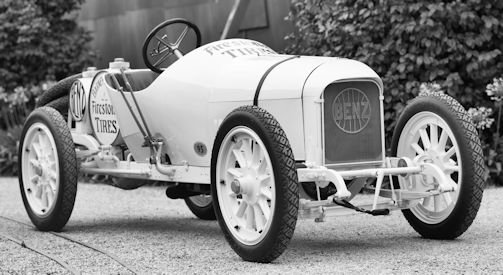
The Benz Prinz Heinrich car also know and sold as Prince Henry was a racing car of the Benz & Cie. , which was built as a reminiscence of the victories of the racing driver Fritz Erle at the Prinz Heinrich ride 1908 (reached with a Benz 50 HP ). It was built only on customer request in individual pieces.
The cars had wooden spoke wheels with pneumatic tires and rigid axles with semi-elliptic leaf springs. They were equipped with a four-speed gearbox, which was connected by a cardan shaft to the rear axle.
The front axle and steering-heads are similarly encased to produce a stream-line form. The same practice is also. applied to the back axle, and there is even evidence of it on the front ends of the rear springs, the Prince Henry type Benz. sheet-metal pyramids attached to them. The front dumb-irons, for a similar reason, are made to look like scythes.
Transmission takes place through a leather-faced cone- clutch, in which a somewhat marked peculiarity is the very slight amount of taper on the cone. The gear-box, which is of the standard sliding-spur-wheel type, gives four forward speeds and a reverse, and the back-axle is of the usual Benz pattern.Alternative gear-ratios are available for altering the gear of the car, and their design is such that the driving-bevel and the crown can be changed for another pair of different ratio without altering the setting. The crown- wheels are dished to a different degree in order to allow for the different number of teeth, and it is thus a very simple matter to make the change. 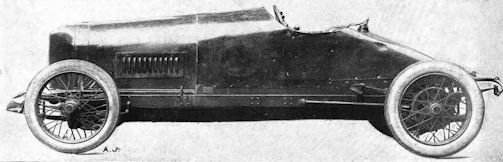
The question of reducing the air-resistance of racing cars has quite taken the place of the former all-important problem of reducing the weight. In the early days races were run for classes of cars restricted to certain weights, Two views Of the engine on the Benz racer. Each cylinder two magnetos working in unison and under these circumstances it was, of course, essential to bring the weight within the specified limit, which in many cases involved drilling away every superfluous scrap of metal that could by any means be eliminated. we find racing cars such as this constructed very much in the same straightforward manner as touring cars, and the attention of the designers is being concentrated on reducing the air-resistance. 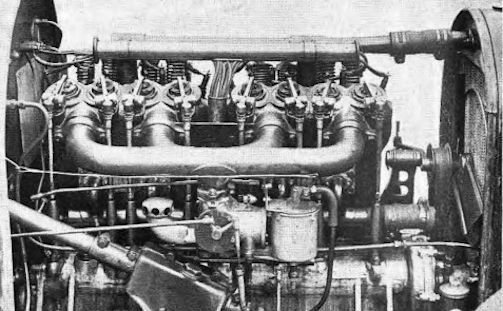
The 80 hp machine an moderate-sized racing car although it is by no means a small engine its bore and stroke are only 105 by 165 mm. The great feature of interest about the engine is the duplication of the valves and the magneto. There are two inlet-valves and two exhaust-valves to every cylinder, and there are two magnetos simultaneously in action on two sets of plugs. The valves are set diagonally in the cylinder heads, the exhaust-valves being on one side and the inlet-valves on the other. The valves are interchangeable. The ignition-plugs lie between the valves, and each set of plugs is independently coupled up to its own magneto. Both plugs are normally in action, but if one or other misfires, the remaining plug continues to do its duty alone.
The magnetos are situated together on one side of the engine, one magneto being a little below the other, for it is obviously impossible to couple them up in tandem owing to the presence of the contact-breaking mechanism, which occupies one end of the magneto as at present constructed. Each piston has two rings, and a special feature of its construction is the provision of an oil pipe which runs diagonally from the centre of the gudgeon-pin to a recess in the piston walls. At the bottom of each stroke this recess comes opposite to an orifice in the cylinder walls and has injected into it a charge of oil, which is fed by a reciprocating pump. When the piston is at the bottom of its stroke the connecting-rod big-end comes under the action of the same oil feed ; this is essentially a supplementary form of lubrication to the main system, which relies on the splashing from the oil chamber.
The lubricator itself is of the multiple plunger type, and lies along-side the engine, its mechanism is enclosed in a rectangular box, which serves as an oil reservoir. A tell-tale on the dashboard indicates whether the pumps are in operation.
The circulation of the cooling-water on this model is effected by a gear- wheel pump, and great care has been taken to strain the water free of any solid particles by a strainer situated on the suction side.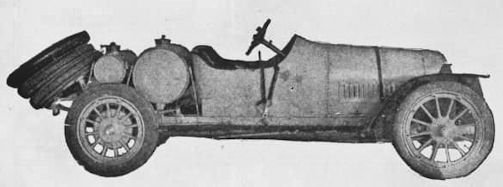
Related
Technical
-
BODY: Optional
SEATING CAPACITY: According to body
WHEEL BASE: 124 inches or optional
GAUGE: 54 or 56 inches
CHASSIS WEIGHT: 2,200 pounds
SPRINGS: Semi-elliptic
BRAKES: Metal to metal on transmission and on rear wheels
CLUTCH: cone, leather faced
CHANGE GEAR: Selective
SPEEDS : Four forward and reverse
DRIVE: Shaft
TIRES, FRONT: Optional sizes
TIRES, REAR: Optional sizes100Hp Engine
CYLINDERS: Four, cast in pairs
BORE: 115 mm.
STROKE:175 mm.
VALVE ARRANGEMENT: Both sides
COOLING: Water
CARBURETER: Benz
IGNITION: Jump spark
CURRENT SUPPLY: Two Bosch high tension magnetos
LUBRICATION: Mechanical systemThe following engines were available:
Construction period
cylinder
capacity
Bore × stroke
power
at speed
1908-1909
4 row
6644 cc
115 mm × 160 mm
80 hp (59 kW)
2000 min -1
1908-1909
4 row
7475 cc
115 mm × 180 mm
105 hp (77 kW)
2000 min -1
1910-1911
4 row
5712 cc
105 mm × 165 mm
80 hp (59 kW)
2500 min -1
1910-1911
4 row
7267 cc
115 mm × 175 mm
100 hp (74 kW)
2500 min -1
© Motor car History

