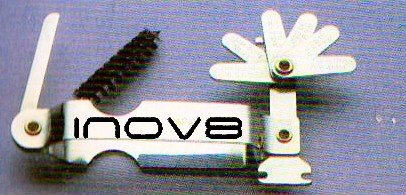
How to Use a feeler gauge
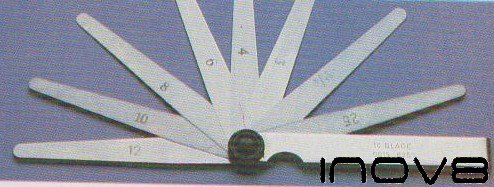
A Typical Car feeler Gauge
A feeler gauge has a number of thin stainless-steel blades, each one of a stated thickness. The figures printed on the blades refer to the thickness in either thousands of an inch ('thou') or hundredths of a millimetre.
You can tell which is which by looking at the range of numbers: 1 to 25 means thousandths of an inch, while 05 to 80 means hundredths of a millimetre. When written as decimals. 25 thou are 0.025 in. and 15 on the metric scale is 0.15 mm. The thicknesses of the blades are chosen so you can make up any thickness you need by combining no more than three blades
As the surfaces of the blades can never touch perfectly. because of microscopic surface grime. there is bound to be a small error when combining thicknesses. Only when you combine more than three does the error become significant. However. A feeler blade or blades should be a sliding fit in a gap of the same thickness to find out what tolerance there is, try measuring a gap as accurately as you can. You will soon get a feel for the difference an extra thousandth of an Inch makes. It the gauge is unwilling to go into the gap. try a size down till you have it just right.
Car Pug Gap Adjuster and Gauge