
Renault Modus
 |
|
| Mark | Renault |
|---|---|
| Years of production | 2004 - 2012
Phase 1: 2004 - 2008 |
| Production | 665,339 copies |
| Class | Motor Car |
| Assembly plant (s) | Valladolid |
| Engines | Gasoline 1,2 75/100 hp 1.4 98 hp 1,6 110 hp Diesel 1,5 dCi 65/70/75/85/90/105 hp |
| Gearbox | Manual 5-speed Manual 6-speed Manual 5-speed automatic 4-speed |
| Unloaded weight | From 1,080 to 1,205 kg |
| Bodywork | 5 doors, 5 seats |
| Length | Phase 1: 3,790 mm Phase 2: 3,874 mm Large: 4,034 mm |
| Width | 1,695 mm |
| Height | 1,590 mm |
| wheelbase | Short: 2,482 mm Large: 2575 mm |
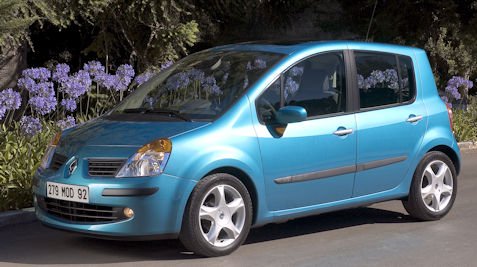
The Renault Modus is an automotive group Renault released in September 2004. Modus offers some of the space-efficiency of an MPV in a compact package. Its sliding two- or three-way split-fold rear bench, split tailgate and specially designed bike rack make it an user-friendly vehicle.
Having the same length as the Clio II, the Modus remains a small city car but, because of its height and the driving position, has a better habitability and visibility. On some versions, the rear seat is fully adjustable and can be advanced or retracted, the backs down or completely folded.By 2007, just before Phase II. There was a slight facelift of the front and rear lights. The turn signals are now transparent, instead of being opaque yellow.
In 2008, the Renault Modus has been restyled, this is especially visible on the front and rear. The front includes a new grille and a new shield, giving the Modus a more modern look. The front lights and air intakes are redrawn, the air intakes are drawn in continuity with the front lights. The tailgate is also redesigned and the taillights become oval. During the restyling, the mirrors become bigger. The Modus has grown 8cm compared to the original phase 1.In addition to the normal version, a version with an extended wheelbase, which has the wheelbase of the Clio III.This elongated version offers superior roominess and a larger trunk volume. The Grand Modus now exceeds 4 meters long . The "Grand Modus" represents the majority of sales of the model. The Modus is not replaced by a similar model , but by the Renault Captur Crossover type based on the chassis of the Clio 4 .In September 2004 , Renault hoped to sell 250,000 to 300,000 Modus a year, but only sold 400,000 copies in three years In 2004, During the restyling, Modus sales increased slightly but still remain below Renault's estimates.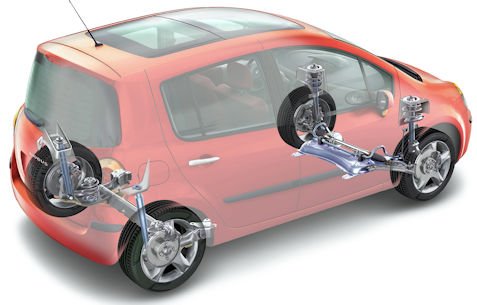
The front suspension, which employs MacPherson type geometry together with an L-shaped lower arm, ensures decoupling of longitudinal and transverse loads. It is therefore possible to provide the high lateral stiffness which benefits roadholding, while absorb-ing longitudinal shocks for the sake of comfort. The front suspension is mounted on a filtered sub-frame, which also contributes to comfort by limiting the transmission of vibration. The rear suspension consists of a programmed-deflection torsion beam together with coil springs. The flexible beam incorporates an anti-roll bar for optimum
control of body movement. The vertical dampers and the long suspension travel ensure good road-handling which combines precision control with comfort. The choice of elasto-kinematic materials for the front and rear suspensions helps to absorb external shocks and plays a part in smooth, efficient chassis performance.
Modus is equipped as standard with electric variable power-assisted steering calibrated to improve steering precision and allow a turning circle of only 9.9m between kerbs.
Petrol engines comprise three 16-valve units: 75hp 1.2, 98hp 1.4, and 113hp 1.6.diesel engine r include the 65hp and 80hp 1.5 dCi units, recognized for their efficiency and low noise levels.
The range of 5-speed manual gearboxes is taken from Mégane Il, with gear ratios adapted to Modus, while the 1.6 16V engine also drives through an automatic transmission.
All these engines operate through drive-by-wire throttle linkage and a motorized throttle valve. They conform with the Euro IV exhaust emission limits and are fitted with an On-Board Diagnostic (OBD) system which ensures that their emission control equipment will continue to function properly over time.
The manual gearboxes taken from the Mégane Il have been adapted for Modus. All the engines drive through manual 5-speed gearboxes of the JH or JR series. With a two-shaft layout, these have torque capacities of 160Nm and 200Nm respectively. These gearboxes are equipped with double-cone synchromesh on the lower two gears (except for the 1.2 16V and 1.4 16V engines) and with a cable type gearshift linkage. Automatic transmission is an option with the 1.6 16V engine: the 4-speed proactive transmission includes flick-shift selection mode. With this system, the driver controls gear selection with a single forward or aft flick of the lever, after moving it sideways into manual mode from the "Drive" position. In this mode upward or downward shifts that would
cause the engine to exceed its operating limits are inhibited. When slowing down, the ratio best-adapted to the vehicle's speed is automatically engaged what- ever the selected mode. It is therefore impossible either to overspeed the engine or to force it to run at less than normal idling speed.
Modus is equipped as standard with Bosch 8.0 ABS system with EBD electronic brake proportioning and emergency brake assist. In an emergency stop, Modus' hazard warning lights automatically switch on. This model is also equipped with dynamic driving control (ESP) with understeer control. This system corrects trajectory by lowering engine torque output and braking to reduce speed. Understeer is controlled by braking two wheels on one side or all four wheels, depending on the degree of understeer.
A traction control function (ASR) for starting from rest or accelerating in low-grip conditions, completes the features of the ESP system. It should be noted that this system can be inhibited below 50kph via a switch on the dashboard for easier starting from rest on loose or uneven surfaces. The system is automatically reset every time the engine is started or when speed exceeds 50kph. Finally, MSR control of engine torque on the overrun prevents the driven wheels locking when the accelerator is released, or when decelerating in low-grip conditions. 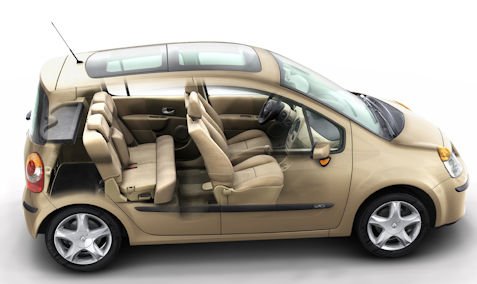
Modus is equipped with SRP3. It includes up to six airbags of which four are side airbags (two thorax side airbags built into the front seats, and two curtain airbags for front and rear head
protection) and two twin-stage adaptive front airbags. in a frontal impact, these safety features are triggered according to the size and position of the front seat occupants. The front seats also with double pretensioners and load limiters. The latter have a 400 daN setting to protect the thorax. A warning buzzer and a pictogram on the dashboard warn the driver should he or she forget to buckle up. 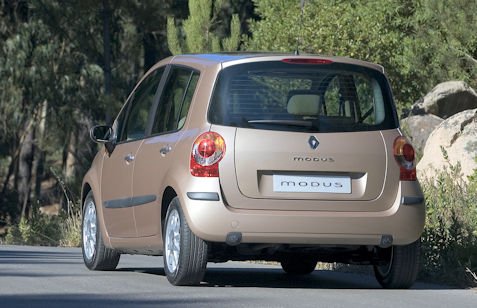
Related
Technical
-
Engine Displacement Power Max torque Max speed
(km / h)0 to 100 km / h Emissions
of CO 2Availability gasoline 1.2 16v 1 149 cm 3 75 hp (55 kW) 107 Nm 163 km / h 13.5s 138 g / km 2004 - 2013 1.2 16v Quickshift 1 149 cm 3 80 hp (58 kW) 107 Nm 167 km / h 15s 134 g / km 2005 - 2010 1.2 TCE 1 149 cm 3 100 hp (74 kW) 152 Nm 182 km / h 11.2s 139 g / km 2007 - 2013 1.4 16v 1,390 cm 3 98 hp (72 kW) 127 Nm 177 km / h 11.4s 167 g / km 2004 - 2008 1.6 16v 1,598 cm 3 110 hp (82 kW) 151 Nm 184 km / h 12.3s 179 g / km 2004 - 2013 Diesel 1.5 dCi 1,461 cm 3 68 hp (50 kW) 180 Nm 158 km / h 15.3s 104 g / km 2008 - 2012 1.5 dCi 1,461 cm 3 75 hp (55 kW) 180 Nm 158 km / h 15.3s 104 g / km 2004 - 2013 1.5 dCi 1,461 cm 3 90 hp (65 kW) 200 Nm 171 km / h 13s 107 g / km 2004 - 2013
Service
-
Engine: Renault Modus 1.2L
Compression ratio - 9.8:1
Ignition Fuel system - Siemens Type Sim 32 M
Diagnostic socket fitted
Firing order - 1-3-4-2
Valve clearance -INLET 0.05-0.012 (check cold)
Valve clearance -EXHAUST 0.15-0.22 (check cold)
Oil pressure - 3.5 Bar @ 4000rpm
Engine oil grade - normal climate 5W/30SAE
Engine oil change - 4.0 litres (with filter)
Manual gearbox oil grade - 75W/80 SAE
Manual gearbox oil refill - 2.8 litres
Cooling system - 5.0 litresNote:
All engines and full specifications available for registered users
© Motor car History
