
Renault Rapid Express
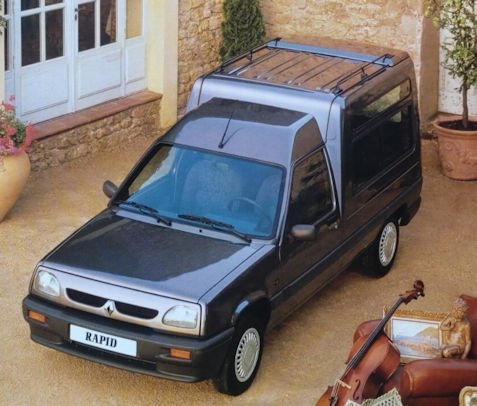 |
|
| Make | Renault |
|---|---|
| Years of production | 1985 - 2000
Phase 1: 1985 - 1991 |
| Production | 1 730 000 |
| Classroom | Light utility |
| Assembly plant (s) | Maubeuge France Palencia Spain |
| Energy | Gasoline , diesel |
| Motor (s) | Petrol Cleon-Cast iron : 956 cc 1 108 cc 1 237 cc 1 390 cc (injection) 1 397 cc Energy : 1 390 cc engine D : 1 149 cc Diesel engine F : 1 596 cc 1,870 cc Electric 21 kW (30 hp) |
| Engine position | Before |
| Gearbox | Manual 4 or 5 speed |
| Unloaded weight | From 775 to 1,245 kg |
| suspensions | Mac Pherson / coil springs front, trailing arms and torsion bars at the rear |
| Direction | rack and assisted according to the models. |
| brakes | Discs in the front, drums in the back |
| Length | 3 982 mm |
| Width | 1,588 mm |
| Height | 1,790 mm |
| Trunk volume | From 710 to 2,600 4 dm 3 |
Appeared in November 1985 within the Renault range , the Renault Express (called Renault Rapid or Renault Extra on certain export markets such as Germany and the United Kingdom) was a light utility..was also sold as Renault Express (eg in France , Spain , Austria , Switzerland , Italy ) or Renault Extra ( United Kingdom and Ireland ).
Technically, the Rapid based on the second generation of the Renault 5 , the so-called "Supercinq" (France). With this model is also - except for a few stylistic changes - to the A-pillar same. Even the dashboard , chassis and the two front doors - from the five-door Renault 5 - were taken over unchanged.
Special features of the Rapid compared to the Renault 5 were on the one hand by about 15 cm extended wheelbase , the roof elevation above the cab and the box body behind the B-pillar . The vehicle was as a non- or partially glazed van version with up to two seats, as a combi with five seats, as pick-up as well as standard equipment as handicapped van or with various special bodies (refrigerated trucks, workshop vehicles available, etc.).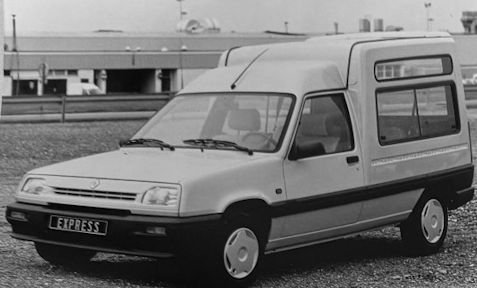
The Renault Rapid was available both as a panel van with two hinged side hinged doors in the rear , as well as a large, openable to the top tailgate . As with its predecessors Renault 4 F4 and F6, the Renault Rapid all wheels were suspended individually : on the front of MacPherson struts and wishbones and the rear of wings with torsion bars , while similar vehicles - such as the VW Caddy or Opel Combo etc. - often still equipped with a rear rigid axle to leaf springs.
The model maintenance took place - as usual with Renault - in several so-called phases.
The first version ( Phase 1 ) was built from mid-1985 to summer 1991. Renault offered for the first time a small van with a 1.6l diesel engine (40 kW / 54 hp), while the petrol engines from the Renault 5 were used. Visible is this model on the almost vertical headlights .
In the summer of 1991, there was a revision to Phase 2 . The engine range changed, since now partly machines were taken over by the Renault Clio . Added to this was, among other things, a 1.9-liter diesel engine with 47 kW (64 hp). This engine with the designation "F8Q" finds modified until today in various models of Renault and Nissan use. Visible was this model on the modernized grille , which was mostly held in gray plastic and aerodynamically slightly cheaper.
The phase 3 of the model was from early 1994 until its replacement by the Kangoo built. The biggest differentiators were high-quality looking materials, the body color grille and the slightly different taillights. An airbag was also available for this model at an extra cost . Not only the safety equipment was upgraded, also the comfort equipment z. B. by a central locking with remote control . In Phase 3, the 1.6l diesel engine fell away and was replaced by a reduced to 40 kW (54 hp) 1.9l diesel engine.
The Express is derived closely from the Renault five, o. However, for certain models, the four-bar rear suspension, found on the Super 5 GT Turbo or 9 and 11 Turbo sports versions and on the 9 and 11 equipped with the 1721 cm 3 ), the wheelbase, door-to-door false and the front face (front mask, wings and hood) are specific.
The body, steel structure self-supporting, designed to balance rigidity and lightness, could be paneled, semi-glazed to clear visibility 3/4 rear, glazed, be equipped with two hinged doors or a tailgate. It has existed in 2 and 5 seats, and a pick-up variant has been provided by the independent coachbuilders company.
The " Cléon-Fonte engines " (gasoline) were arranged transversely at the front, and coupled to a four or five-speed gearbox + reversing appeared on the Renault 9 and 11. The displacements were 956, 1,108 and 1,397 cc .
On the newer models, a 1.4-liter " Energy Engine " of 80 horsepower was also available, much more modern engine (overhead camshaft) and economical, as well as the " engine D " of 1.2 type D7F of 60 horses.
The 956 cc was quickly abandoned due to limited performance and high consumption. Renault also proposed diesel engines, a 1.6-liter F- type " F-engine ", derived from the F2N block of 1721 cc gasoline, the latter two already seen under the hood of the Super 5, 9 and 11, then the " engine F "type F8Q of 1.9 liter diesel, inaugurated by the Renault 19 .
The gearbox is type JB, 4 or 5 synchronized reports, identical to the boxes of 5, 9 and 11, but reports to the different staging. The steering is classic, rack-and-pinion, optional or series-assisted on the latest models.
This is a front wheel drive. The front suspensions are independent, with coil springs and shock absorbers and anti-roll bar derived directly from the 5; On some models, not all, the rear axle is "rigid deformable" also called "programmed", with 4 torsion bars and hydraulic shock absorbers.
The braking , of the hydraulic type dual circuit is mixed, solid disc at the front, rear drums, assisted by a vacuum brake booster. The parking and emergency brake is cable operated and operates the rear drum jaws.
This car has existed in electric variant, rare. It was also equipped with the entry level Super 5 dashboard , the latter being modified to receive the equipment relating to its mode of propulsion (battery gauge, for example).
In direct competition with the Citroën C15 and the Fiat Fiorino , the Express van was a great success among the light trucks, and eventually settled in succession to the Renault 4 Fourgonnette .
It was also available in five-seater version. This car has so many similarities with the Super 5 and Clio Diesel that it is possible to replace, relatively simply, the original engine with a larger engine of the same origin Renault, as the powerful 1.7 liter 120 hp turbocharged from Volvo 440 and 480 turbo, or the 2 liter Clio Williams / Megane, or even the 1.9 L Turbo Diesel R19, the F block is common to these engines . For gasoline versions, it remains the possibility of supercharged engine 1397 cc Super 5 GT Turbo and R9 and R11 Turbo . However, it should be noted that all these alternative fixtures are of course illegal and reserved for use in a closed circuit.
For export, mainly in Germany , the van was named Renault Rapid as well as the United Kingdom (the name is already used by Talbot for the twin brothers Citroën C25 - Peugeot J5 and Fiat Ducato I ); and was equipped according to legislation, the engine Cléon-Fonte ", also depolluted (presence of an EGR, a catalyst .) and often a much more abundant equipment (storage over the driver, digital clock, rear window defrost, fog lights, etc.). The latest models are also equipped, as an option or series, with power steering, tinted electric windows and more. far from the rustic apparatus of the beginnings.
It is from the presentation of the Renault Kangoo that the express van begins its end of career. In 1997 , only three versions of the Express remain: RN, RL and Extra. In 1998 , the 5-seater version disappears, only the 2-seater versions remain in the catalog. The Express disappears in July 2000 .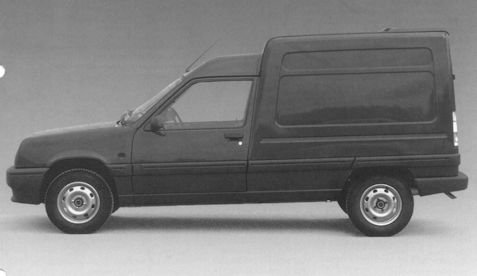
Related
Service
-
Engine: Renault Rapid/Express 1.4L Petrol
No. of cylinders -4
Capacity - 1397cc
Compression ratio - 9.2:1
Suitable for unleaded petrol -yes
Ignition system - Renix AEI
Firing order - 1-3-4-2
Valve clearance -INLET 0.15 (check cold)
Valve clearance -EXHAUST 0.20 (check cold)
Oil pressure - 3.5 Bar @ 4000 rpm
Engine oil grade - normal climate 10W/30SAE
Engine oil change - 3.5 litres (with filter)Note:
All engines and full specifications available for registered users© Motor-car.net
