
Renault Trafic II
 |
|
| Years of production | 2000 to 2014 Phase 1: 2000 - 2006 Phase 2: 2006 - 2014 |
|---|---|
| Classroom | Light utility |
| Assembly plant (s) | Luton Barcelona |
| Motor (s) | Petrol 2.0 16v 120 hp Diesel 1.9 dCi 82/100 hp 2.0 dCi 90/115 hp 2.5 dCi 150 hp |
| Engine position | transversal front |
| Displacement | From 1,995 to 2,464 cm 3 |
| Maximum power | 150 ch |
| Maximum torque | 350 Nm |
| Transmission | Traction |
| Gearbox | Manual 5 reports Manual 6 reports Robotized 6 reports |
| Unloaded weight | From 1,879 to 2,186 kg |
| Maximum speed | 180 km / h |
| Mixed consumption | 8.6 L / 100 km |
| Emission of CO 2 | From 195 to 229 g / km |
| Bodywork | Truck Combi 4 doors, seats 2-9 van 4 doors, seats 2-3 |
| brakes | Front: DV 305 Rear: DP 280 |
| Length | 4,782 to 5,180 mm |
| Width | 1900 mm |
| Height | 1,960 to 2,460 mm |
| wheelbase | 3,098 to 3,490 mm |
| Trunk volume | 1,240 dm 3 |
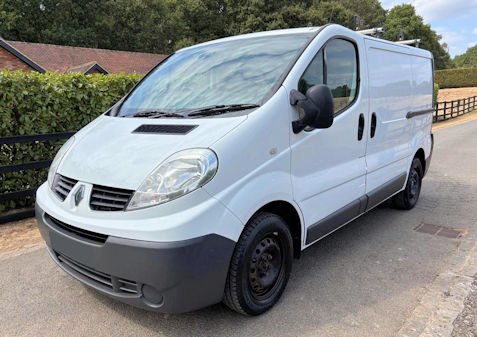
The Renault Trafic II is a Commercial vehicle marketed by Renault from September 2000.Following a production agreement between Renault and the American General Motors , it is sold under several names: Renault Trafic II, Opel / Vauxhall Vivaro and Nissan Primastar .Production takes place at the GM Vauxhall plant in Luton (Bedfordshire) and the Nissan plant in Barcelona (Catalonia).
The design was designed by Renault , the lines are more rounded, the opposing doors with windows that make a round the turn of the vehicle.The engines, which are now transverse, are (on phases 1) gasoline (rare) 120 hp or turbo-diesel direct injection of 80,100 and 140 hp.
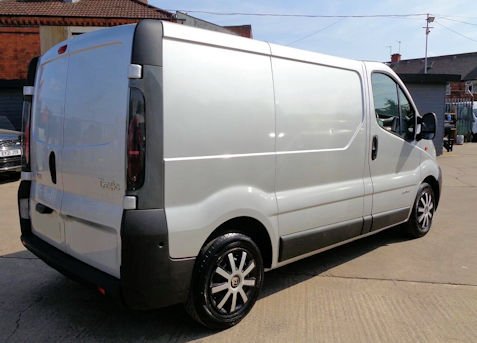
In October 2006, it is Phase 2, Trafic II receives Euro 4 standard engines as well as a front bumper and modified front and rear lights.In 2012, the range of engines has been reduced and the gasoline engine is no longer marketed.Finally, the traffic was derived in several forms with the choice between a cabin floor (2 or 3 seats depending on the configuration) - a deep cabin (with 5 or 6 seats thanks to to the 3 additional seats in the second row) -a bucket -combi (with 8 or 9 seats depending on the configuration) .Thus, the traffic 2 was configurable according to his needs, and more with short or long versions but also low or raised.In June 2014, Traffic II is replaced by Traffic III and in 2016, Primastar will be replaced by Nissan NV300 .
Related
Technical
-
Engines
2000 on
gasoline- 2.0 16S: 120 hp at 4,750 rpm; 1998 cm 3 /4-cylinder / 16 valve
Diesel
- 1.9 dCi 82: 82 hp at 3500 rpm; 1870 cm 3 /4-cylinder / valve 8
- 1.9 dCi 100: 100 hp at 3500 rpm; 1870 cm 3 /4-cylinder / valve 8
- 2.5 dCi 140: 135 hp at 3500 rpm; 2464 cm 3 /4-cylinder / 16 valve
2006 to 2012
gasoline
- 2.0 16V: 120 hp at 4,750 rpm; 1998 cm 3 /4-cylinder / 16 valve
Diesel
- 2.0 dCi 90: 90 hp at 3500 rpm; 1 995/1 996 cm 3 /4-cylinder / 16 valve
- 2.0 dCi 115: 115 hp at 3500 rpm; 1 995/1 996 cm 3 /4-cylinder / 16 valve
- 2.5 dCi 150: 146 hp at 3500 rpm; 2464 cm 3 /4-cylinder / 16 valve
2012 to 2014
Diesel
- 2.0 dCi 90: 90 hp at 3500 rpm; 1995 cm 3 /4-cylinder / 16 valve
- 2.0 dCi 115: 115 hp at 3500 rpm; 1995 cm 3 /4-cylinder / 16 valve
Service
-
Engine: Renault Trafic II 2.2L Petrol OHC (2165cc)
Compression ratio - 9.2:1
Ignition system - Renix
Fuel system - Siemens
Diagnostic socket -fitted
Valve clearance -INLET 0.10-0.15 check cold
Valve clearance -EXHAUST 0.20-0.25 check cold
Oil pressure - 3 Bar @ 3000rpm
Engine oil grade - normal climate 10W/30 SAE Semi-synth
Engine oil change - 6.5 litres (with filter)
Manual gearbox oil grade - 80W SAE
Manual gearbox refill - 1.8 litresNote:
All engines and full specifications available for registered users© Motor car History
