
Renault Master I
 |
|
|---|---|
| Production period: | 1980 to 1997 |
| Class | Commercial vehicle |
| designs: | Panel van , flatbed , minibus |
| Engines: | Gasoline : 2.0-2.2 liter diesel : 2.1 to 2.5 liters |
| Length: | 5000 mm |
| Width: | 2000 mm |
| Height: | 2415 mm |
| Wheelbase: | 2870-3700 mm |
| Payload: | 1.67 t |
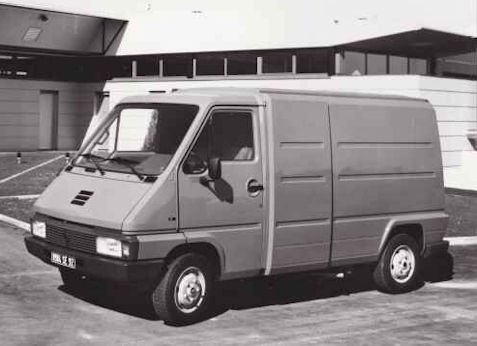
The Renault Master is a medium-sized van from Renault since the 1980's.
As a successor of the Renault Estafette , the Renault Master first came to the market in the summer of 1980 together with the Renault Trafic and is designed for the larger total weight class of 2.8 to 3.5 tonnes.
The master was made in the 1980 SoVAB factory ( Société des Véhicules Automobiles de Batilly ) in the department of Meurthe -et-Moselle , where later also some variants of the Trafic ran off the line. The first series was characterized by a sloping bonnet, which went without kink in the windshield. In addition, the circular, smoothly fitted into the body surface door handles fell on. At that time unusual in the segment was the front-wheel drive with longitudinally installed engines, which brought a high position of the driver's cab.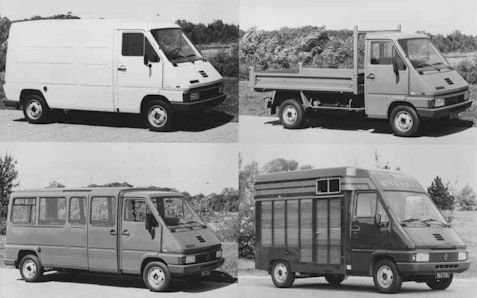
The master was available with three different wheelbases (2.87, 3.23 and 3.70 m) and as a minibus , panel van , flatbed , minibus and chassis for bodies. The gross vehicle weight was 2.8, 3.0, 3.1 and 3.5 tonnes. There were two different roof heights. A maximum of 9 to 12.7 m³ could be loaded in the panel van. As a drive, a 2.0-liter gasoline engine with 59 kW / 80 hp from the Renault 20 or a 2.55-liter diesel engine with 52 kW / 71 hp was used. This engine came from Fiat- SOFIM , which Renault was involved in at the time, and was also featured in the contemporary Iveco Daily and Fiat Ducato installed.
The Master was also available with rear and four-wheel drive . These versions with some higher payloads were offered as Renault Messenger and replaced the Renault Super Goelette SG2 .
In 1984, there was also a 2.1-liter diesel engine with 44 kW / 61 hp and a 2.2-liter gasoline engine with 66 kW / 90 hp.In 1989, the revised SOFIM diesel engine with now 55 kW / 75 hp and by turbocharger 65 kW / 88 hp in the program. From 1990 this now made 69 kW / 94 hp.
In mid-1994, a light facelift and the turbo diesel engine was now available with a catalyst and 66 kW / 90 hp power, while the 2.2-liter gasoline engine now provided 75 kW / 101 hp.In late 1997, the production of the first Renault Master was discontinued. Especially in the 1980s this was also very successful in export due to the many possible variations in construction, weights and drive options.
In addition, the Master has been developed and produced since the second generation together with General Motors Europe. From this cooperation the Vauxhall / Opel Movano emerges. The Renault Master II won after his performance in 1998, the title Van of the Year .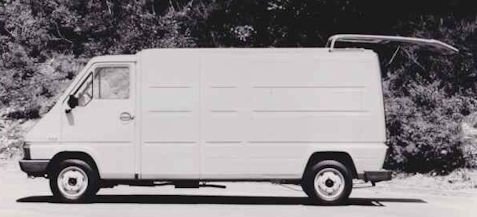
Related
Service
-
Engine: Renault Master I 2.1D OHC (2068cc)
Compression ratio - 21.5:1
Injection system - RotoDiesel
Injection sequence - 1-3-4-2
Nozzle opening pressure - 113-125 Bar
Glow plug - part no.Bosch 0250 201 006
Valve clearance - INLET 0.20 (Check cold)
Valve clearance - EXHAUST 0.25 (Check cold)
Oil pressure - 3 Bar @ 3000rpm
Engine oil grade - normal climate 10W/40 SAE
Engine oil change - 6.0 litres (with Filter)
Manual gearbox oil grade - 75W/80 SAE
Manual gearbox oil refill - 2.5 litres
Brake fluid - Type DOT 4Note:
All engines and full specifications available for registered users© Motor car History
