
Renault Laguna I
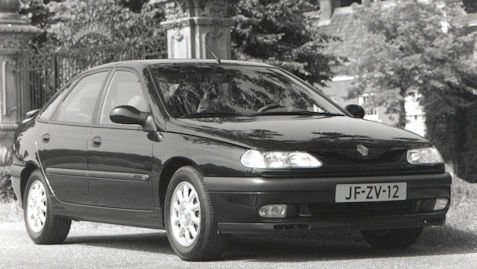 |
|
| Make | Renault |
|---|---|
| Years of production | 1994 to 2001
Phase 1: 1994 - 1998 |
| Production | 2,350,800 |
| Class | Motor Car |
| Assembly plant | Sandouville Palencia |
| Fuel types | Gasoline , diesel and LPG |
| Engines | Gasoline F :1794 cm 31998 cm 3 K motor :1598 cm 3 Modular Volvo :1948 cm 3 V6 PRV :2963 cm 3 V6 ESL :2946 cm 3 Diesel G :2188 cm 3 Diesel turbo F :1 870 cm 3 G :2 188 cm 3 |
| Engine position | Front |
| Displacement | From 1,598 to 2,963 cc |
| Maximum torque | From 142 to 267 Nm |
| Gearbox | Manual 5 speed |
| Unloaded weight | From 1,090 to 1,480 kg |
| Bodywork | Sedan sedan 5 doors, 5 seats Break (Nevada) 5 doors, 5 seats |
| Length | Sedan : 4,510 mm Break : 4,630 mm |
| Width | 1,752 mm |
| Height | Sedan : 1 440 mm Break : 1 470 mm |
The Renault Laguna was marketed between 1994 and 2001. It existed in five-door sedan (including the hatchback ) and in station wagon version too.
In January 1994, after 8 years of success, Renault replaced the popular Renault 21 with an elegant 5-door sedan the new Laguna. The lines are inspired by the Safrane , with even more elegance, awarded the prize of the most beautiful car of the year of 1994. The philosophy of this new Renault is based on total control of quality, both for the assembly and for the materials used.
The Laguna is distinguished by its very ergonomic interior, with a very original dashboard with all controls at hand, the extension of the dashboard in the front door panels with integration of the ventilation grilles in the doors. The horn control is on the steering wheel (a first for a French car) .The Laguna distinguishes itself from the outset by remarkable damping and comfort. In addition, its neat interior shows the progress made by Renault in terms of quality control since the late 1980s. It is one of the first models of the brand, with Renault 19 Baccara and RSi, Espace Grand Écran and V6, and Safrane RT to provide an airbag optional driver side.
Unlike the Renault 21, which offered 4 and 5-door bodies, the Laguna is only made in 5 doors, respecting the choice of the customer who abandons the classic versions in this range of models. For phase 2 in 1998, the anti-corrosion treatment is further improved. Apart from the problems on diesel engines 1.9 dTi and 1.9 dCi, the first Laguna, is a model known for its reliability .
Phase I (1994 - 1998)
Marketed from January 14, 1994. The range in Phase 1 is articulated around four levels of finishes: RN, RT, RXE and V6 . The equipment is very limited on the basic models, but becomes better once reached the mid- range .
The sporty vocation of the Laguna under the name of the finish "2.0 S" or "RTi", the Laguna, with monograms "16v" on the front doors and being endowed with the " Modular engine " 2 liters 16v (1 948 cc ) from Volvo (type N7Q) of 140 hp (the engine of the Volvo S40 / V40 ), a specific velvet upholstery with gray and black patterns, and a three-spoke steering wheel , which will equip later the Mégane coupe . In July 1999, this Volvo block is replaced by an " engine F " Renault 2 liters 16v (1,998 cc ) F4R more modern, 136 hp , but offering more torque and lower fuel consumption.
From October 1996, the Laguna adopts a new logo on the tailgate, with the appearance of the third brake light, passive safety improvements (including modifications under the dashboard to prevent leg injuries), new steering wheel. The equipment is revised upwards over the entire range. 1997, the first diesel engine with direct injection at Renault: the 1.9 liter dTi (" F engine ") of 100 hp ( turbo), replacing the atmospheric 2.2 D. This 1.9 dTi despite its intrinsic qualities of low consumption, suffer from problems of youth: the accessory belt tends to break causing a shift in the distribution and therefore the destruction of the engine, problem solved by a recall on a large scale.
Phase II (1998 - 2001)
The Laguna was restyled in April 1998, in addition to displaying new levels of finish (RNE, RTE, RXE, RXT), the front face is modified by new headlights.
The front bumper is also retouched, with the installation of round foglamps that will be included on the Megane I phase 2 , Scénic I phase 2 and Twingo I phase 3 . The "gills" spoiler characteristic of Phase 1 is abandoned for a simple plastic band, which raises the ground clearance to the front. The monograms naming the engines and finishes are also reviewed. The equipment and passive safety are also improved, including the standard fitting of the head / side airbags and the SRP (Restraint system with force limiter on the front belts). In April 1997, the last Laguna phase 1 had already undergone some passive safety improvements (including modifications under the dashboard to prevent leg injury).
At the technical level, new gasoline engines are emerging: a 1.6-liter, 16-valve , 110- hp , a 1.8- liter, 16-valve, 115-hp, and a two-liter, 16-valve, 136-hp . These engines are considered ideal on the Laguna, their low consumption combined with very respectable performance for the 1.6 liter, to a car extremely pleasant to lead with the 2 liters. The diesels are also reviewed, the big 2.2 liters dT receives a turbo with a variable geometry that improves the availability of its power and its torque, then appear the very first declination of the 1.9 liter dCi (" engine F ") of 110 hp , inaugurating the principle of the common injection rail ( common rail ) at high pressure at Renault. The first dCi will see their common ramps flee and their injectors to seize.A more powerful version will be released in 1995, Laguna Biturbo Hartge. The preparer Hartge will graft the engine of the Safrane Biturbo , to obtain an exceptional car. It displays a maximum speed of 254 km / h , an acceleration of 0 to 100 km / h in 7 seconds, and travels the 400 m start in 14.7 s and the 1000 m start in 26.9 s . Renault will not market it, because of the failure of the Safrane bi-turbo. The engine is a 12 " V6 PRV engine of 2 963 cm 3( 93 x 72.7 mm ), powered by two turbos . It delivers a maximum power of 280 hp at 5,500 rpm for a torque of 399 Nm at 3,000 rpm , generating a weight / power input of 5.34 kg / hp and a torque / weight ratio of 267 Nm / T . It is equipped with a five- speed manual gearbox , the power is transmitted to the front wheels.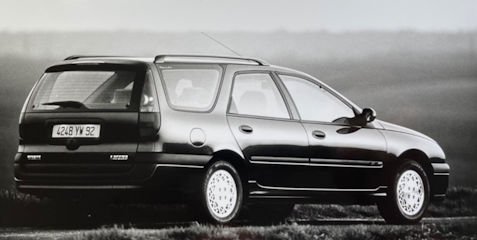
Related
Technical
-
Renault Laguna RN 1.8
Engine: 4 cylinders in line front transverse 1.794 cc.
Max power kW 66 (bhp DIN 90) at 5.750 rpm.
Max torque Nm 144 at 2.750 rpm.
Compression ratio 9,7:1.
Bore/stroke 82,7 x 83,5 mm.
Power/litre 50,1 bhp.
Power/weight 13,6 kg/t)hp.
Performances:
top speed 180 km/h, 0-100 km/h 13,9sec.
Fuel consumption DIN (at 120 km/h) 8,2 litres/100 k m. 11.150Renault Laguna RT 2.0
Engine: 4 cylinders in line front transverse 1.998 cc.
Max power kW 83 (bhp DIN 115) at 5.200 rp m.
Max torque Nm 168 at 3.500 rp m,
Compression ratio 9,8:1.
Bore/stroke 82,7 x 93,0 mm.
Power/litre 57,5 bhp.
Power/weight 10,8 kg/bhp.
Performances: top speed 200 km/h, 0-100 km/h 10,6 sec.
Fuel consumption DIN (at 120 km/h) 7,7 litres/100 k mRenault Laguna V6 3.0
Engine: 6 cylinders in vee front transverse 2.963 cc.
Max power kW 123 (bhp DIN 170) at 5.500 rp m.
Max Nm 235 at 4.500 rp m
Compression ratio 9,6:1.
Bore/stroke 93,0 x 72,7 mm.
Power/litre 57,4 bhp. Power/weight 8 kg/bhp.
Performances: top speed 220 km/h, 0-100 km/h 8,6 sec.
Fuel consumption DIN (at 120 km/h) 9,9 litres/100 k m
Transmission:
front.
5 speed manual.
Auto optionSteering
power assisted.Brakes:
front ventilated discs.
Rear drums.Suspension:
front McPherson independent wheels, coil springs, coil springs.
Rear independent arms, coil springs, anti-roll bar.Tyres:
185/65 VR 14.
V6 205/60 VR 15Dimensions:
length 4,46 m
width 1,72 m
height 1,42 m.
Turning circle 11,50 m
Kerb weight 1.225 kg.
Tank capacity litres 66.
© Motor car History
Service
-
Engine: Renault Laguna I 3.0L 24V
Compression ratio - 10.5:1
Ignition fuel system - Bosch Type Motronic MP7.0
Diagnostic socket -fitted
Firing order - 1-6-3-5-2-4
Valve clearance -INLET Hydraulic
Valve clearance -EXHAUST Hydraulic
Oil pressure - 1.2 Bar
Engine Oil grade - normal clinate
172 Engine oil grade - moderate climate 10W/30 SAE
Manual gearbox oil grade - 75W/80 SAE
Cooling System - 7.0 litresNote:
All engines and full specifications available for registered users© Motor car History
